Barbara Montagu
| Name | Barbara Montagu |
| Title | English noblewoman (c.1722–1765) |
| Gender | Female |
| Birthday | 1722-00-00 |
| nationality | England |
| Source | https://www.wikidata.org/wiki/Q18572306 |
| pptrace | View Family Tree |
| LastUpdate | 2025-11-26T12:28:37.399Z |
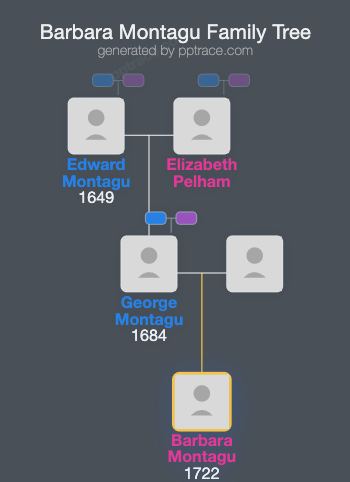
Family Tree
Tap  to expand more relatives
Introduction
Lady Barbara Montague (circa 1722 – August 1765) was a British philanthropist and charity worker. She is known for sponsoring programs aimed primarily at assisting impoverished women. Montague was born around 1722 to George Montagu, 1st Earl of Halifax, and Lady Mary Lumley, daughter of Richard Lumley, 1st Earl of Scarbrough. She had six sisters and one brother, who became George Montagu-Dunk, 2nd Earl of Halifax, after changing his surname upon marrying heiress Anne Richards, a legatee of Sir Thomas Dunk. Following her father’s death, each of his daughters was allocated £5,000; Montague's income was placed in an annuity providing approximately £100 annually.
As an unmarried woman in the 18th century, Montague's circumstances were atypical, given societal expectations that women live with family or marry. She suffered from a serious heart condition, which made marriage unsuitable. In 1748, she met Sarah Scott, an English novelist and translator, whose family background included Yorkshire gentry and connections to Elizabeth Montagu, a prominent figure in the Blue Stockings Society. After a severe bout of smallpox in 1741, Scott was considered unfit for marriage and pursued writing and intellectual activities.
Montague and Scott established a household in Bath, creating a community of women facing similar societal constraints. Montague engaged in various charitable endeavors, including the creation and sale of educational cards containing geographical, historical, and mathematical facts, with proceeds supporting local poor neighbors. She also encouraged knitting schemes among impoverished women, producing mittens sold within their community. Additionally, Montague supported Scott’s efforts in establishing Sunday school classes for children.
In 1751, Scott married, but within a year, her father and brother removed her from her husband's household, leading Scott and Montague to rejoin their community in Bath. The community comprised women such as Elizabeth Cutts, Sarah Fielding, and possibly Jane Collier, who supported each other both psychologically and financially. They promoted the publication of their writings to raise funds for charitable work. For instance, Montague funded the publication of "The Histories of Some of the Penitents in the Magdalen House, as Supposed to Be Related by Themselves" in 1759, which addressed issues facing penitent prostitutes; the preface, authored by Montague, defended charity.
The women organized a small industrial school to teach basic skills to poor girls and some boys. In 1763, Montague received a pension of £300, which enhanced their financial stability. Montague died in August 1765 and was interred at the Church of St Mary, Charlcombe. According to her will, she returned a £100 annuity previously provided by her brother and bequeathed over £1,000 to her sisters, community members, servants, and students she supported. The majority of her estate was left to Sarah Scott outright, with stipulations that, in the event of Scott’s remarriage, the funds would not fall under her spouse's control. Sarah Scott lived for three decades after Montague’s death, benefiting from her estate and adhering to the charitable principles they had established together.