Thomas Grenville
| Name | Thomas Grenville |
| Title | Royal Navy officer killed in action during the War of the Austrian Succession |
| Gender | Male |
| Birthday | 1719-04-03 |
| nationality | Great Britain |
| Source | https://www.wikidata.org/wiki/Q7790187 |
| pptrace | View Family Tree |
| LastUpdate | 2025-11-26T23:23:17.324Z |
Family Tree
Tap  to expand more relatives
Introduction
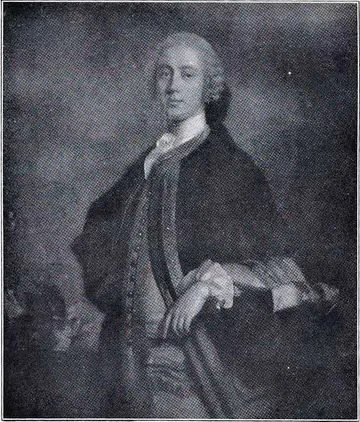
Thomas Grenville (4 April 1719 – 3 May 1747) was an officer in the Royal Navy and served as a Member of Parliament for Bridport. He participated in military operations during the War of the Austrian Succession.
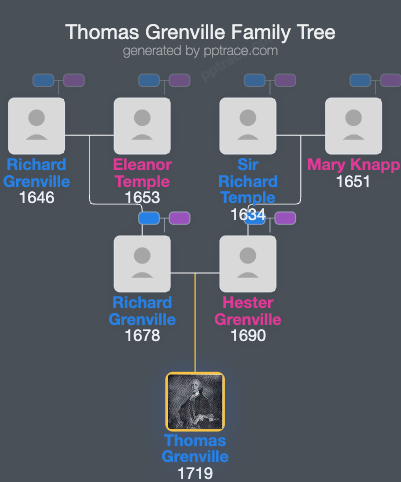
Born on 4 April 1719, Thomas Grenville was the seventh son of Richard Grenville, a politician. He had at least two older brothers, George Grenville and Richard Grenville, who became notable politicians in their own right. George Grenville served as Prime Minister from 1763 to 1765. Thomas Grenville was also brother-in-law to William Pitt, 1st Earl of Chatham. The Grenville family was associated with the Patriot Whig faction, also known as the Cobham Cubs, led by their uncle, Lord Cobham.
Thomas Grenville entered the Royal Navy and attained the rank of lieutenant by 1740. By 1742, he held the rank of captain. On 6 April 1742, he was appointed commander of the 50-gun HMS Romney. During a naval operation off Cape St. Vincent in March 1743, Grenville captured a Spanish vessel traveling from Veracruz to Cádiz. The cargo was valued at approximately £120,000 to £130,000, and Grenville estimated his share at between £30,000 and £40,000, although the actual amount was likely less than that estimate.
Following this achievement, Grenville was assigned to command the 50-gun HMS Falkland and served off the coast of Ireland. In 1746, he was transferred to the 60-gun HMS Defiance. That same year, he was elected as a Member of Parliament for Bridport, a naval port town, on 12 December 1746.
In early 1747, Grenville was scheduled to undertake an independent cruise, influenced by his brother George Grenville, who was serving as one of the lords of the admiralty. However, his orders were changed at short notice, and he was ordered to join the fleet commanded by George Anson. Anson’s fleet encountered a French squadron under the command of the Marquis de la Jonquière off Cape Finisterre. On 3 May 1747, the Battle of Cape Finisterre took place, resulting in a decisive victory for Anson’s fleet.
During the engagement, Grenville was wounded when a large splinter struck his left thigh. The injury necessitated the amputation of his leg. Despite the amputation, Grenville died from his wounds approximately five hours after the injury, on 3 May 1747. His body was returned to England for burial, and a memorial was erected in his honor by his relative at Stowe House. He was buried at the family estate in Wotton Underwood.
The contemporary from George Lyttelton noted that the victory's joy was marred by the loss of Captain Grenville, describing him as a promising young officer likely to have been a national honor had he survived.