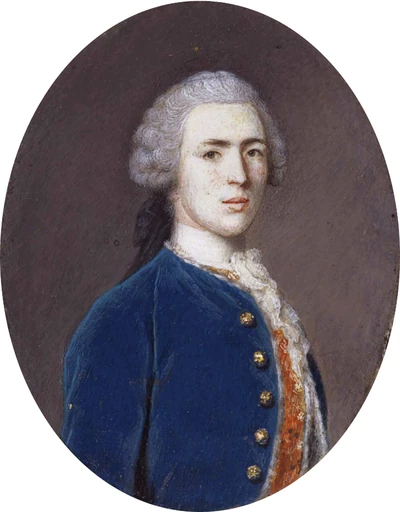
George Walpole, 3rd Earl Of Orford
| Name | George Walpole, 3rd Earl Of Orford |
| Title | British peer (1730-1791) |
| Gender | Male |
| Birthday | 1730-04-02 |
| nationality | — |
| Source | https://www.wikidata.org/wiki/Q5545843 |
| pptrace | View Family Tree |
| LastUpdate | 2025-11-26T23:20:33.322Z |
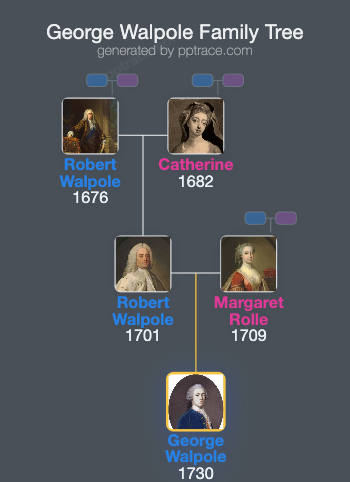
Family Tree
Tap  to expand more relatives
Introduction
George Walpole, 3rd Earl of Orford (2 April 1730 – 5 December 1791), was a British administrator, politician, and peer. He was the only son of Robert Walpole, 2nd Earl of Orford, and Margaret Rolle, who held the title of Baroness Clinton in her own right. His parents separated shortly after his birth. His father's mistress, Hannah Norsa, a singer and actress at Covent Garden, resided at Houghton Hall from 1736 until Robert Walpole's death in 1751.
In 1751, following his father's death, Walpole succeeded as the 3rd Earl of Orford. His mother remarried later that year and was buried at Livorno (Leghorn) in 1781. She was characterized as a person of singular character, and described as half-mad by some accounts. Walpole was engaged to Margaret Nicoll, an heiress, but the engagement was disrupted by his uncle, Lord Walpole of Wolterton. Margaret Nicoll subsequently married the Duke of Chandos.
Walpole resided at Houghton Hall in Norfolk from 1751 to his death in 1791. He served as High Steward of King's Lynn and High Steward of Yarmouth, both significant ports at the time due to transatlantic trade. He was also a Lord of the Bedchamber to King George II until the monarch's death, and subsequently served King George III until 1782. From 1757, he held the position of Lord Lieutenant of Norfolk. During the Seven Years' War in 1758, he played an active role in reforming the county militia, appointing George Townshend and Sir Armine Wodehouse as colonels of the West and East Norfolk Regiments, respectively. He personally commanded the West Norfolk Militia during the American War of Independence in 1778, implementing reforms such as improved recruitment, supplies, amphibious training exercises, and musketry practice.
Apart from his military roles, Walpole was known for his interest in falconry and hare coursing. He founded the Swaffham Coursing Club in 1776, which became a leading organization in England, with members naming their greyhounds after letters of the alphabet and organizing various competitions and prizes.
He was also noted for his eccentricity and extravagance, reportedly stemming from financial difficulties inherited from his father. Walpole never married and left no legitimate heirs. He possibly had an illegitimate daughter, Georgina Walpole, with Mary Sparrow of Eriswell. Upon his death at age 61, his titles—except for the barony of Clinton, which could pass through the female line—were inherited by his uncle, Horace Walpole. The Houghton estate remained with the Walpole family.
Walpole is also remembered for the 1778 sale of his grandfather Robert Walpole’s collection of art to Catherine the Great of Russia. The sale was initially intended to be secret, but it became public and was viewed as a national loss. The collection of 204 paintings became part of the Hermitage Museum in St Petersburg, with 126 paintings still housed there today. This sale caused significant concern in Britain, prompting petitions from the trustees of the British Museum for their purchase and the construction of new facilities for British collections.
He was buried in the Church of St Martin at Tours on the Houghton Hall estate.