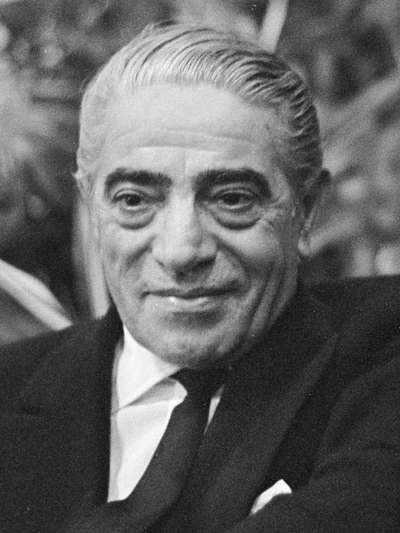
Aristotle Onassis
| Name | Aristotle Onassis |
| Title | Greek shipping magnate |
| Gender | Male |
| Birthday | 1906-01-20 |
| nationality | Greece |
| Source | https://www.wikidata.org/wiki/Q180455 |
| pptrace | View Family Tree |
| LastUpdate | 2025-11-17T06:44:57.253Z |
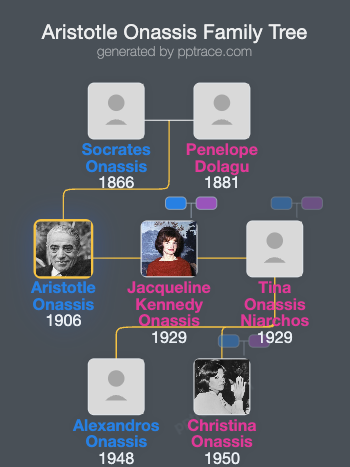
Family Tree
Tap  to expand more relatives
Introduction
Aristotle Socrates Onassis (Greek: Αριστοτέλης Ωνάσης; January 20, 1906 – March 15, 1975) was a Greek and Argentine business magnate, notable for amassing the world’s largest privately owned shipping fleet and for his prominence in international business. He was born in Smyrna, Ottoman Empire, to Greek parents, Socrates Onassis and Penelope Dologlou. His early life was marked by the complex political and social upheavals of the region.
Onassis had one sister, Artemis, and two half-sisters, Kalliroi and Merope, by his father's second marriage. His family owned substantial property in Smyrna, but due to the occupation of Smyrna by Greece after World War I and the subsequent Turkish re-occupation during the Greco-Turkish War, the family lost their property. The Great Fire of Smyrna in 1922 further devastated their holdings, prompting the family to flee to Greece. During this period, Onassis’s uncles, aunt, and her family perished in the fire.
In 1923, Onassis emigrated from Greece to Argentina with $250, arriving in Buenos Aires where he initially worked as a telephone operator for the British United River Plate Telephone Company. Simultaneously, he studied commerce and port-duty administration at Aduanas Argentinas. He established an import-export business, specializing in English-Turkish tobacco, and eventually built a considerable fortune, reportedly including shipping ventures used for trafficking heroin, as he later claimed to opera singer Maria Callas. He gained Argentine citizenship in 1929 and founded the shipping company Astilleros Onassis in Buenos Aires.
Following his success in Argentina, Onassis expanded his business globally, relocating to New York City to develop his shipping empire while maintaining offices in Buenos Aires and Athens. His fleet grew to over seventy vessels, mostly operating under flags of convenience, such as Panama and Liberia, to reduce regulation costs. His operational practices, including operating ships with minimal navigational equipment and regulations, drew scrutiny after incidents such as the 1970 oil spill involving the Liberian-registered SS Arrow.
In 1953, Onassis moved to Monaco, where he gained control of Société des bains de mer de Monaco (SBM) through a series of front companies in Panama. As head of SBM, he acquired key properties in Monaco, including the Monte Carlo Casino, the Hôtel de Paris, and other assets. His relationship with Monaco’s ruler, Prince Rainier III, was initially cooperative but soured over disagreements regarding tourism development and investments in hotel construction. Ultimately, Onassis sold his holdings in SBM and left Monaco in 1967 after legal challenges to his control.
During the 1950s, Onassis engaged in negotiations with the Saudi monarchy to establish an oil transportation arrangement, aiming to export Saudi oil on his tankers. Plans for this deal were complicated by the U.S. government, which sought to prevent the end of American oil companies’ monopoly over Saudi oil exports. The American government pursued policies to nullify or hinder the Saudi-Onassis agreement, reflecting broader geopolitical and economic tensions of the period.
Throughout his career, Onassis was married to Athina Mary Livanos and had a long-standing affair with opera singer Maria Callas. In his later years, he was married to Jacqueline Kennedy, the former First Lady of the United States. He experienced personal tragedy with the death of his son, Alexander, in 1973, and died two years later in 1975.