Robert H. Robinson
| Name | Robert H. Robinson |
| Title | American Methodist minister (1824-1909) |
| Gender | Male |
| Birthday | 1824-01-01 |
| nationality | United States of America |
| Source | https://www.wikidata.org/wiki/Q104680500 |
| pptrace | View Family Tree |
| LastUpdate | 2025-11-17T06:36:33.579Z |
Family Tree
Tap  to expand more relatives
Introduction
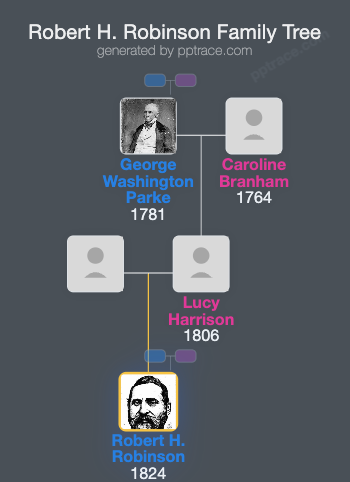
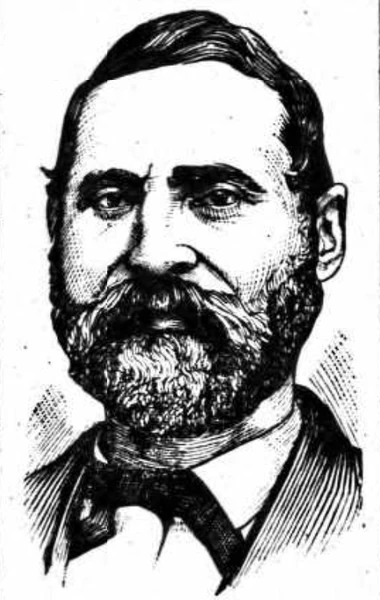
Rev. Robert Henry Robinson (1824–1909) was an American minister, educator, and activist for the rights of African Americans during the Antebellum period in Arlington, Virginia. He was born into slavery and was the grandson of Caroline Branham, a woman involved in negotiations for his eventual emancipation. His mother was Lucy Branham. His slaveholder was George Washington Parke Custis, a grandson of Martha Washington.
In the 1820s, Caroline Branham participated in interviews with historian Jared Sparks, under the condition that her grandson, Robinson, be freed. In 1834, Robinson was sold to a Quaker named Miller and apprenticed to a banker and businessman from Arlington named Robert Jamieson. During this apprenticeship, he learned literacy and arithmetic. He was emancipated in January 1846, at the age of 21.
Robinson was ordained as a minister by Bishop Matthew Simpson, who served as an adviser to President Abraham Lincoln. He served as a pastor at Roberts Chapel, a Methodist Episcopal Church established by African Americans, located on South Washington Street in Alexandria, Virginia. He contributed to the creation of the Western Conference of the Methodist Episcopal Church, the first conference for African Americans. Between 1872 and 1876, Robinson was the first African American member of the Board of Church Extension Society of the Methodist Episcopal (M.E.) Church.
Throughout his career, Robinson served churches across multiple states, including Virginia, West Virginia, Maryland, Pennsylvania, and the District of Columbia. He moved to Charleston, West Virginia, in 1883 and later served at the McKendree M.E. Church in Cumberland, Maryland, by 1894. He also engaged in educational and community initiatives, such as establishing a night school and a debate team for freedmen, and served as treasurer of the William McKinley Normal and Industrial School in Alexandria.
In 1864, Robinson and two of his sons organized one of the earliest Emancipation Day observances in Alexandria, Virginia. The event drew notable figures such as Booker T. Washington, Frederick Douglass, and John M. Langston. In addition to his ministerial work, Robinson was involved in politics and civic organizations; in 1854, he became the fourth Grand Master of the Freemasons for the District of Columbia and later held the same position in West Virginia in the 1880s.
Robinson married on September 23, 1847. His sons, R.B. Robinson and Magnus L. Robinson, established the African American political newspaper The Washington National Leader in 1888, with R.B. serving as business manager and Magnus as managing editor. Frederick Douglass Jr. served as an associate editor.
He died on November 22, 1909. In 1911, a monument approximately ten feet high was erected in his memory at Bethel Cemetery on South Payne Street in Alexandria, Virginia, by his sons. His wife and sons were interred nearby. The Robert H. Robinson Library at the Alexandria Black History Museum was named in his honor. He is also commemorated on the "Truths that Rise from the Roots" monument in Alexandria, Virginia.