Yamagata Aritomo
| Name | Yamagata Aritomo |
| Title | Prime Minister of Japan (1838-1922) |
| Gender | Male |
| Birthday | 1838-06-14 |
| nationality | Japan |
| Source | https://www.wikidata.org/wiki/Q297636 |
| pptrace | View Family Tree |
| LastUpdate | 2025-11-17T10:07:34.694Z |
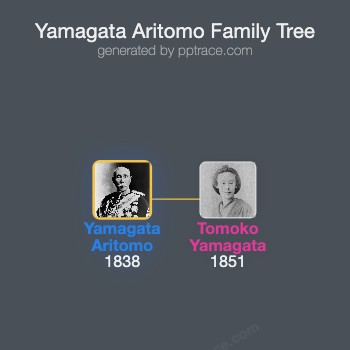
Family Tree
Tap  to expand more relatives
Introduction
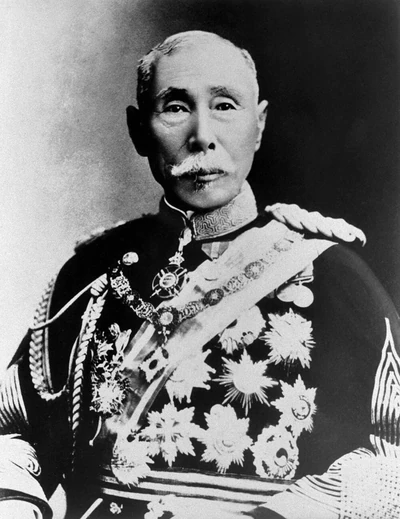
Prince Yamagata Aritomo (山縣 有朋), born on June 14, 1838, in Hagi, Chōshū Domain (present-day Yamaguchi Prefecture), was a Japanese statesman and military leader. He died on February 1, 1922. Yamagata was a descendant of a low-ranking samurai family; his father, Yamagata Arinori, belonged to the chūgen (foot soldier) class within the samurai hierarchy. His early upbringing was marked by the death of his mother at age five and subsequent care by his grandmother, Katsu. His education included classical Chinese and Japanese literature, poetry composition, and military training such as fencing, spearmanship, and jujitsu.
During his youth, Yamagata held minor bureaucratic positions within the han (feudal domain) administration, including roles as an errand boy, a servant in a han school, and an informer in han police organizations. His family’s domain, Chōshū, underwent significant reforms in the 1830s under Daimyō Mōri Takachika, emphasizing military modernization and strengthening finances. These reforms influenced Yamagata’s perspectives on modernization and military development.
In 1858, at age twenty, Yamagata was dispatched to Kyoto as an intelligence agent for Chōshū, recommended by Yoshida Shōin, a prominent ideological mentor. This assignment marked his transition into broader political activism during the turbulent bakumatsu period. The arrival of Western powers, notably Commodore Perry in 1853, catalyzed the sonnō jōi movement, which aimed to restore imperial authority and expel foreigners. Yamagata associated with radical sonnō jōi activists and was influenced by their ideology.
He studied under Yoshida Shōin at the Shōka Sonjuku academy after returning to Hagi in 1858. Following Yoshida’s execution in 1859, Yamagata became a key figure among radical Chōshū loyalists. He participated in military campaigns such as the Shimonoseki campaign and was wounded during the 1864 bombardment by a multinational Western fleet. This experience demonstrated to him the importance of Western military technology.
Yamagata led a military faction during internal Chōshū conflicts, notably participating in the "Chōshū Restoration" coup in 1865, which aimed to overthrow the Tokugawa shogunate. He served as an officer in the Kiheitai, an innovative militia unit composed of men from various social classes, including commoners. His leadership in amphibious raids during the Second Chōshū expedition in 1866 exemplified his military capabilities. Takasugi Shinsaku, the leader of Kiheitai, chose Omasa Masujirō over Yamagata for command following Takasugi’s death in 1867. Nevertheless, Yamagata played a vital role in the Boshin War (1868), leading forces in campaigns that contributed to the Meiji Restoration.
Following the end of the shogunate, Yamagata engaged in military reform. He traveled to Europe between 1869 and 1870 with Saigō Tsugumichi to study Western military systems, with special admiration for Prussian tactics. Upon returning, he became Assistant Vice Minister of Military Affairs and was instrumental in establishing the Imperial Japanese Army, including creating the Imperial Bodyguard unit. He oversaw the implementation of a comprehensive conscription system through the 1872 Conscription Act, which aimed to create a modernized, national army and weaken the samurai class’s traditional privileges.
He served as Home Minister, where he centralized police and local government administration. Yamagata’s first term as Prime Minister spanned from 1889 to 1891, during which he oversaw the first Imperial Diet under the Meiji Constitution. He engaged in political disputes with Itō Hirobumi, advocating for a government composed of non-partisan bureaucrats directly accountable to the emperor, contrasting with Itō’s approach of constitutional compromise with political parties.
Yamagata’s second term as Prime Minister occurred from 1898 to 1900, after the First Sino-Japanese War (1894–1895). During this period, he enacted laws to restrict the political influence of party members within key bureaucratic positions. He increased his influence within the Meiji oligarchy after Itō Hirobumi’s assassination in 1909. Following this, he consolidated power as a dominant figure in Japan’s imperial court; however, his influence waned shortly before his death due to a political scandal involving interference in Crown Prince Hirohito’s engagement.