Charles Douglas-Home
| Name | Charles Douglas-Home |
| Title | British journalist (1937-1985) |
| Gender | Male |
| Birthday | 1937-09-01 |
| nationality | United Kingdom |
| Source | https://www.wikidata.org/wiki/Q5076943 |
| pptrace | View Family Tree |
| LastUpdate | 2025-11-26T13:01:40.151Z |
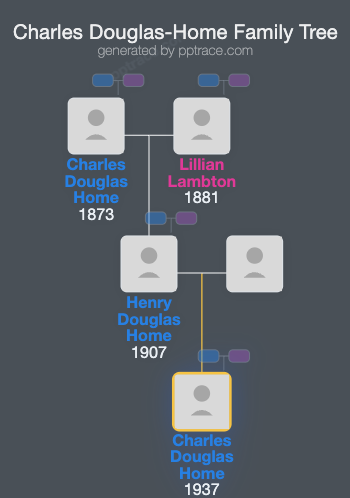
Family Tree
Tap  to expand more relatives
Introduction
Charles Cospatrick Douglas-Home (1 September 1937 – 29 October 1985) was a Scottish journalist known for his role as editor of The Times from 1982 until his death in 1985.
Born in London, Douglas-Home was the younger son of the Honourable Henry Douglas-Home and Lady Margaret Spencer. His familial connections include his uncle, Sir Alec Douglas-Home, a former British Prime Minister, and his first cousin, John Spencer, 8th Earl Spencer, the father of Diana, Princess of Wales.
He received his education at Eton College, where he was recognized as a King's Scholar. In 1956, he joined the British Army, serving in the Royal Scots Greys. After his military service, Douglas-Home spent approximately nine months in Canada, supporting himself by selling books and encyclopaedias.
Subsequently, he served as aide-de-camp to Sir Evelyn Baring, the Governor of Kenya during the Mau Mau insurgency, in 1958–1959. This experience cultivated his interest in international politics; he later authored a biography of Baring titled "Evelyn Baring: the Last Proconsul" in 1978.
Upon returning to the United Kingdom, Douglas-Home sought a career in television but was rejected due to his accent and lack of journalistic training. He then commenced work in newspapers, initially covering breaking news for the Scottish Daily Express. Feeling dissatisfied with this work, he was promoted by Beaverbrook Newspapers to serve as deputy to Chapman Pincher, the Defence correspondent of the Daily Express in London. This position proved engaging and affirmed his interest in journalism.
Building a network through his family connections, Douglas-Home developed contacts within Parliament and Whitehall. After eighteen months, he became the principal political and diplomatic correspondent for the Express. His views diverged from the paper’s opposition to British entry into the European Communities, which led to his appointment in 1965 as defence correspondent for The Times, succeeding Alun Gwynne-Jones. During this tenure, he covered events such as the Six Days War and the Soviet invasion of Czechoslovakia.
In 1970, Douglas-Home was appointed features editor, and in 1973, he became home editor. William Rees-Mogg appointed him foreign editor in 1978. In 1981, when Rupert Murdoch acquired The Times, Douglas-Home was considered for the editorship; however, Harold Evans was appointed instead, with Douglas-Home serving as his deputy.
Following a fallout between Murdoch and Evans over editorial independence, Douglas-Home succeeded Evans as editor in 1982. He oversaw a period of stabilization and improvement for The Times, which had suffered from a year-long closure and the dismissal of Evans. Under his leadership, the newspaper’s circulation doubled to approximately 500,000 copies.
Douglas-Home maintained a conservative editorial stance but was committed to impartial news reporting. He continued editing the paper while battling a prolonged illness and died of cancer at the age of 48. He was survived by his wife, Jessica Violet Gwynne, and two sons, Tara (born 1969) and Luke Douglas-Home (born 1971). His successor as editor was Charles Wilson.
In his honor, the Charles Douglas-Home Memorial Trust Award was established to recognize contributions in areas aligned with his interests, including Defence, Foreign Affairs, Democracy, the Royal Prerogative in the 21st Century, and Music. As of 2025, the trust primarily functions to nominate award winners and raise funds. Past recipients include The Kyiv Independent, Ross Clark, Jamie Blackett, Julia Pettengill, Douglas Murray, and others.
External links: Charles Douglas-Home Memorial Trust