Francis Charles Lawley
| Name | Francis Charles Lawley |
| Title | British politician |
| Gender | Male |
| Birthday | 1825-05-24 |
| nationality | United Kingdom of Great Britain and Ireland |
| Source | https://www.wikidata.org/wiki/Q5480488 |
| pptrace | View Family Tree |
| LastUpdate | 2025-11-26T12:24:21.819Z |
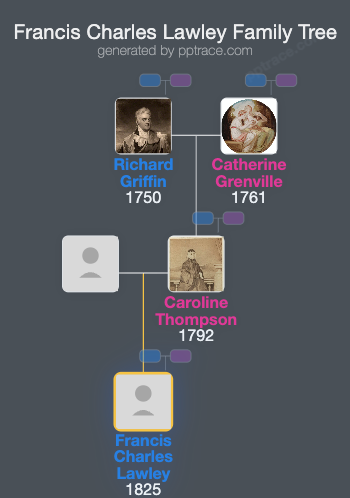
Family Tree
Tap  to expand more relatives
Introduction
Francis Charles Lawley was born on 24 May 1825. He was the youngest son of Paul Thompson, 1st Baron Wenlock. Lawley received part of his education in Hatfield before attending Rugby School in May 1837. He graduated from Balliol College, Oxford, in 1848 with a degree in Literae Humaniores, earning second-class honours.
He commenced legal studies at the Inner Temple in 1847 but was not called to the bar. Instead, he obtained a Bachelor of Civil Law (BCL) degree. In 1852, Lawley was elected as a Member of Parliament (MP) for Beverley. During the same year, he served as private secretary to William Ewart Gladstone, who was then the Chancellor of the Exchequer.
In June 1854, Lawley was considered for the governorship of South Australia. However, his prospects were eliminated following a political scandal that led to his resignation from public office. Lawley was known to have a strong passion for horse-racing and gambling, which contributed to financial difficulties. It was publicly revealed in August 1854 that he had used insider information—obtained from his role at the Exchequer—to speculate on the Funds, aiming to recover lost funds. This exposure resulted in his resignation from Parliament and his position as Gladstone's secretary. Despite the insider information involved, Lawley did not profit financially from these transactions, with Lord Henry Lennox commenting that Lawley's main fault was losing money on the Funds despite knowing the inside information.
Following the decline of his political career, Lawley moved to the United States in 1856. There, he worked as a correspondent for The Times during the American Civil War, reporting on the Confederate Army. He authored several books, including "The Bench and the Jockey Club" and "The Life and Times of the Druid," and contributed articles to magazines such as St Paul's Magazine.
In 1865, Lawley returned to London, where he became a writer for The Daily Telegraph. His financial situation continued to be problematic, resulting in bankruptcy proceedings in 1874 and 1881. After his death on 18 September 1901, legal proceedings against his estate continued.
References and additional information about his contributions to Parliament can be found in the Hansard archives covering the years 1803 to 2005.