Éléonore Desmier D'Olbreuse
| Name | Éléonore Desmier D'Olbreuse |
| Title | Grandmother of George II of Great Britain and great-grandmother of Frederick the Great |
| Gender | Female |
| Birthday | 1639-02-03 |
| nationality | France |
| Source | https://www.wikidata.org/wiki/Q65304 |
| pptrace | View Family Tree |
| LastUpdate | 2025-11-12T01:15:34.564Z |
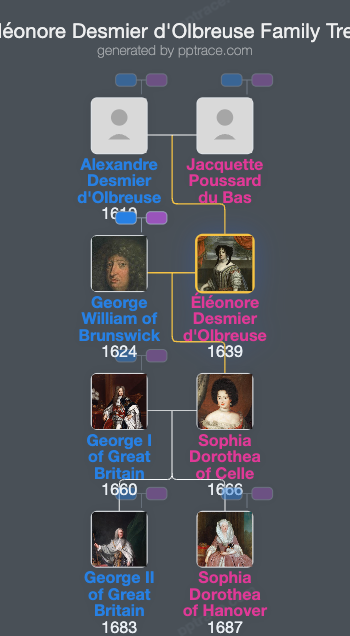
Family Tree
Tap  to expand more relatives
Introduction
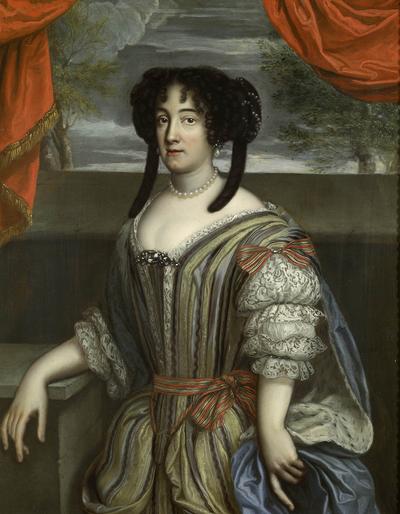
Éléonore Desmier d'Olbreuse (3, 7, or 9 January 1639 – 5 February 1722) was a French noblewoman of Huguenot descent. She was born at the Castle of Olbreuse, located in what is now Deux-Sèvres near Niort in Poitou, France. Her parents were Alexandre Desmier, seigneur d'Olbreuse, and Jacquette Poussard du Bas-Vandré.
In 1661, Éléonore moved to the royal court in Paris, serving as a lady-in-waiting to Marie de La Tour d'Auvergne, Duchess of Thouars. During the winter of 1664, Éléonore accompanied Emilie, daughter of William V, Landgrave of Hesse-Kassel, on a visit to Kassel. It was there that she met George William of Brunswick, Prince of Calenberg, with whom she began a love affair.
George William entered into a secret morganatic marriage with Éléonore in 1665 after relinquishing his rights to his domains of Calenberg and Lüneburg—transferring them to his brothers—to marry her. She received the title of "Lady of Harburg" (Frau von Harburg), and they had a daughter, Sophia Dorothea, born on 15 September 1666.
The marriage style initially limited Éléonore's official status; nonetheless, she was able to raise her daughter and engage in religious and social activities, including founding a Reformed church in Celle. In 1674, by imperial order, she and her daughter were granted the higher title of "Countess of Harburg and Wilhelmsburg" with allodial rights over certain domains.
George William sought to improve Éléonore's status further, especially to facilitate a marriage alliance for her daughter with George Louis (later King George I of Great Britain). In 1675, George William declared his marriage to Éléonore was not morganatic, and their marriage was duly recognized with a second ceremony in 1676. This recognition caused concern among familial and political circles due to succession considerations, as George William did not produce a male heir.
Despite opposition, on 13 July 1680, family agreements recognized Éléonore as Duchess of Brunswick and declared her daughter Sophia Dorothea a princess with full rights. The 1682 marriage of Sophia Dorothea to George Louis, the future King George I, was marked by tensions, with the bride's family and the bride herself experiencing difficulties in her marriage. Their union produced two children: George Augustus (born 30 October 1683), who became King George II of Great Britain, and Sophia Dorothea (born 16 March 1687), who became Queen consort in Prussia and Electress of Brandenburg.
In 1694, Sophia Dorothea engaged in a scandalous affair with Count Philip Christoph von Königsmarck. After the affair was discovered, von Königsmarck was presumed murdered by order of George Louis, and Sophia Dorothea was placed under house arrest in the Castle of Ahlden, remaining imprisoned for life. Éléonore, her mother, endeavored to secure her release but was unsuccessful.
George William died in 1705, and Éléonore received Lüneburg Castle as her widow's residence. Attempts by Sophia Dorothea to live openly with her mother were refused. In her later years, Éléonore sought assistance from King Louis XIV of France to free her daughter but declined to convert to Catholicism as a condition.
Éléonore Desmier d'Olbreuse died on 5 February 1722 at Celle Castle, nearly blind. She was buried in the Fürstengruft at the Stadtkirche St. Marien in Celle. Her will listed 342 beneficiaries.