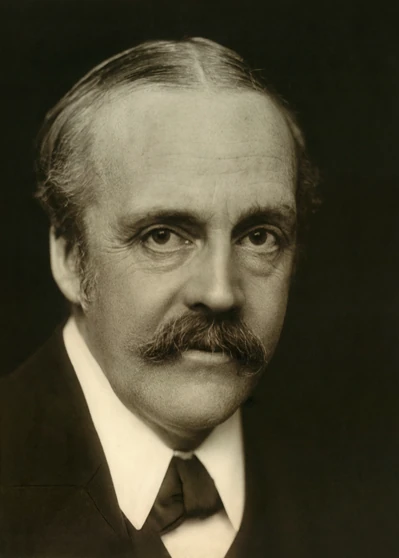
Arthur Balfour
| Name | Arthur Balfour |
| Title | British Prime Minister, Conservative politician, and statesman (1848-1930) |
| Gender | Male |
| Birthday | 1848-07-25 |
| nationality | United Kingdom |
| Source | https://www.wikidata.org/wiki/Q19008 |
| pptrace | View Family Tree |
| LastUpdate | 2025-11-26T23:31:05.844Z |
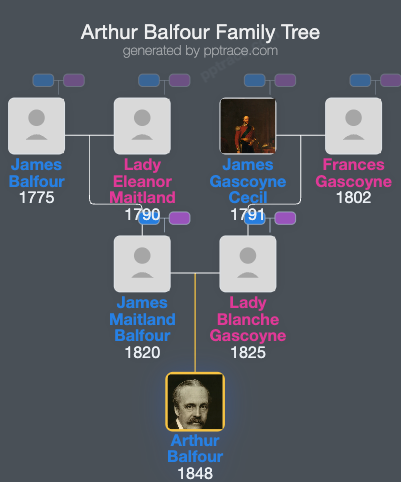
Family Tree
Tap  to expand more relatives
Introduction
Arthur James Balfour, 1st Earl of Balfour (25 July 1848 – 19 March 1930), was a British statesman and Conservative politician. He served as Prime Minister of the United Kingdom from 1902 to 1905. Balfour held the position of foreign secretary during the Lloyd George ministry, notably issuing the Balfour Declaration of 1917, which expressed support on behalf of the British cabinet for establishing a "home for the Jewish people" in Palestine. Additionally, he issued the Balfour Declaration of 1926 as Lord of the Privy Council, which outlined a co-equal relationship between the United Kingdom and its Dominions. This declaration contributed to the legal foundation of the Statute of Westminster 1931, granting full legislative independence to the former colonies.
Born at Whittingehame House in East Lothian, Scotland, Balfour was the eldest son of James Maitland Balfour and Lady Blanche Gascoyne-Cecil. His family lineage includes Scottish ancestors from Fife and political connections through his mother to the Cecil family, descended from Robert Cecil, 1st Earl of Salisbury. His godfather was the Duke of Wellington. Balfour was the third of eight children, with siblings Eleanor, Evelyn, Cecil, Alice, Francis Maitland (a Cambridge embryologist), Gerald, and Eustace (an architect). He was educated at Grange Preparatory School, Eton College, and Trinity College, Cambridge, where he studied moral sciences from 1866 to 1869.
Balfour remained a lifelong bachelor. He met May Lyttelton in 1870; after developing a close relationship, she died of typhus in 1875. Balfour kept a memorial ring buried with her. He later maintained a close friendship with Mary Charteris, Lady Elcho, with whom he may have had a relationship. He was involved in the social and intellectual circle known as The Souls.
Beginning his parliamentary career in 1874, Balfour was elected as Conservative MP for Hertford, serving until 1885, after which he represented Manchester East from 1885 to 1906. He served as private secretary to his uncle, Lord Salisbury, then Foreign Secretary, during the Congress of Berlin. He contributed to the public discourse on international politics and published a philosophical work, Defence of Philosophic Doubt, in 1879.
In 1885, Salisbury appointed Balfour President of the Local Government Board, and in 1886, he became Secretary for Scotland. In 1887, he was appointed Secretary for Ireland, a position in which he aimed to suppress agrarian unrest and address absentee landlord issues. He opposed Irish Home Rule, asserting that Ireland could not remain in the UK or become independent with partial autonomy.
Balfour was a prominent figure in the Conservative Party, becoming its leader in the House of Commons in 1891 under Salisbury's government. He succeeded Salisbury as Prime Minister in July 1902. His domestic policies included passing the Land Purchase (Ireland) Act 1903, which bought out most Anglo-Irish landowners, and the Education Act 1902, which reformed the school system in England and Wales. The act supported Anglican and Catholic schools but faced opposition from Nonconformists.
During his tenure as Prime Minister, Balfour oversaw reforms of British defence, supported naval innovations led by Jackie Fisher, and negotiated the Entente Cordiale with France, improving Anglo-French relations. He supported imperial preference initiatives advocated by Joseph Chamberlain but faced party divisions over free trade policies. Controversies related to the later stages of the Boer War, including the conduct of counter-insurgency efforts and the use of Chinese labour in South Africa, contributed to public dissatisfaction.
Balfour resigned as Prime Minister in December 1905. The Conservative Party suffered a decisive defeat in the 1906 general election, and Balfour lost his parliamentary seat. He returned to Parliament shortly thereafter and served as Leader of the Opposition until 1911, when he resigned as party leader. During World War I, he served as First Lord of the Admiralty (1915–1916) and later as Foreign Secretary (1916–1919) in the coalition government led by David Lloyd George. His tenure included the issuance of the Balfour Declaration.
Balfour continued to be active in politics throughout the 1920s, holding senior positions until his death in 1930 at age 81. He accumulated a substantial inherited fortune during his lifetime. He was educated as a philosopher and was known for his analytical and detached approach to life. He never married and remained a significant figure in British political history until his death.