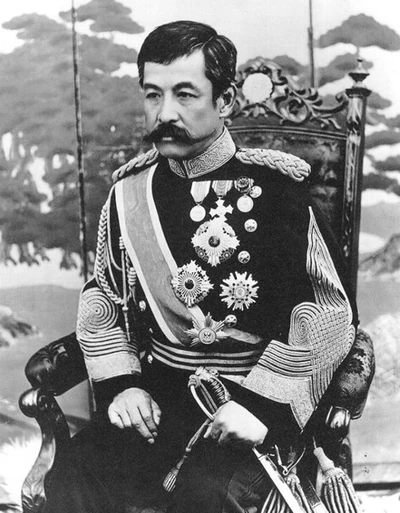
Prince Kitashirakawa Yoshihisa
| Name | Prince Kitashirakawa Yoshihisa |
| Title | Japanese prince |
| Gender | Male |
| Birthday | 1847-04-01 |
| nationality | Japan |
| Source | https://www.wikidata.org/wiki/Q3197569 |
| pptrace | View Family Tree |
| LastUpdate | 2025-11-17T10:09:28.349Z |
Family Tree
Tap  to expand more relatives
Introduction
Yoshihisa, Prince Kitashirakawa (北白川宮能久親王, Kitashirakawa-no-miya Yoshihisa-shinnō), was born on April 1, 1847, and died on October 27, 1895. He was a member of the Japanese imperial family and served as the second head of a collateral branch of the imperial lineage.
Early life and Family:
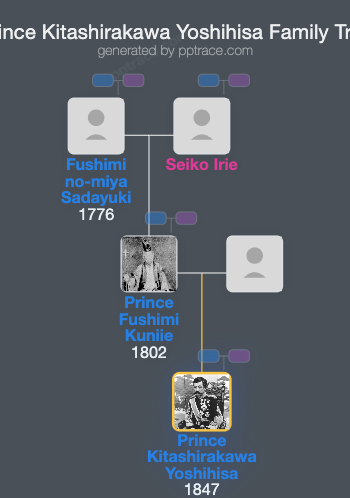
Yoshihisa was the ninth son of Prince Fushimi Kuniie (1802–1875) and Horiuchi Nobuko. He initially entered the Buddhist priesthood, adopting the name Rinnoji-no-miya, and served as the abbot of Kan'ei-ji in Edo.
Historical Context and Political Activity:
During the Bakumatsu period, amid the unrest of the Boshin War aimed at overthrowing the Tokugawa shogunate, Yoshihisa fled northward with pro-Imperial forces following the Satsuma-Chōshū victory in Edo. He was appointed as the nominal head of the "Northern Alliance" (Ōuetsu Reppan Dōmei), a coalition comprising nearly all northern Japan domains, under the leadership of Date Yoshikuni of Sendai. There are documents that refer to Yoshihisa as "Emperor Tōbu" (Tōbu-tennō or Tōbu-kōtei), indicating a potential claim or planned establishment of a northern court, with proposed era names such as Taisei or Enju. However, historians are divided regarding whether Yoshihisa was officially recognized as an emperor.
Post-Restoration Career:
Following the Meiji Restoration, in 1873, Emperor Meiji revoked the ecclesiastical status of princes serving as Buddhist clergy, restoring their secular standing. In the same year, Yoshihisa succeeded his younger brother, Prince Kitashirakawa Kasunari, as the second head of the princely house of Kitashirakawa-no-miya.
Marriage and Offspring:
On July 10, 1886, Yoshihisa married Shimazu Tomiko (October 1, 1862 – March 20, 1936), who was adopted by Prince Shimazu Hisamitsu of Satsuma Domain. They had one child, Prince Kitashirakawa Naruhisa (April 18, 1887 – April 2, 1923). Yoshihisa also had five sons and five daughters by various concubines, reflecting the customary practices of his time.
Military Career:
Yoshihisa pursued a career in the military, receiving training in Germany. Upon his return to Japan in 1887, he was commissioned as a major general in the Imperial Japanese Army. In 1893, he reached the rank of lieutenant general and commanded the 4th Division. During the First Sino-Japanese War (1894–1895), he was transferred to the 1st Division and participated in Japan's invasion of Taiwan. During the campaign, he contracted malaria and died outside Tainan, Taiwan. His death marked the first time an imperial family member died abroad, and he was the first modern member of the Japanese imperial family to die in wartime.
Religious Enshrinement:
Under the State Shinto system, Yoshihisa was deified as a kami and was enshrined in various Shinto shrines established during Japanese rule in Taiwan, as well as in Yasukuni Shrine.
Honors and Recognitions:
Yoshihisa received numerous honors, including the Grand Cordon of the Order of the Rising Sun on December 31, 1875, and the Grand Cordon of the Supreme Order of the Chrysanthemum on December 29, 1886. Posthumously, he was awarded the Order of the Golden Kite, 3rd class, on November 1, 1895.
Foreign awards included knighthoods from several monarchies: the Grand Cross of the Red Eagle from Prussia, the Grand Cross of the Griffon from Mecklenburg, the Knight Grand Cross of Kamehameha I from the Kingdom of Hawaii, the Order of St. Alexander Nevsky from Russia, and the Knight Grand Cross of Leopold from Austria-Hungary.
Sources:
The details are referenced from several publications, including Trevor N. Dupuy's "The Harper Encyclopedia of Military Biography," T. Fujitani and Alvin D. Cox's "Splendid Monarchy: Power and Pageantry in Modern Japan," Marius B. Jansen's "The Making of Modern Japan," Donald Keene's "Emperor of Japan: Meiji and His World," Sugiyama Takie Lebra's "Above the Clouds," and Yoshitaro Takenobu's "The Japan Year Book."