Thomas Penn
| Name | Thomas Penn |
| Title | son of William Penn, founder of the Province of Pennsylvania |
| Gender | Male |
| Birthday | 1702-03-20 |
| nationality | Great Britain |
| Source | https://www.wikidata.org/wiki/Q7793095 |
| pptrace | View Family Tree |
| LastUpdate | 2025-11-26T23:23:04.222Z |
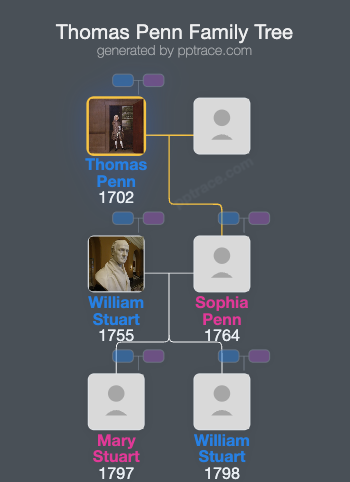
Family Tree
Tap  to expand more relatives
Introduction
Thomas Penn was born on 8 March 1702 (Old Style) in Kensington, London. He was the son of William Penn, a notable Quaker religious thinker, writer, and founder of the Province of Pennsylvania, and Hannah Callowhill Penn, who married William Penn on 5 March 1696. The Penn family lived in Pennsylvania, specifically in the Pennsbury Manor area of present-day Bucks County, from 1682 to 1701 before returning to England. Despite William Penn's role as the proprietor of Pennsylvania, the family’s income from the colony was limited.
Following William Penn’s death in 1718, the proprietorship of Pennsylvania was assigned by his will to his three sons, including Thomas Penn. In 1727, William Penn’s will, which was contested by children from his first marriage to Gulielma, was upheld in British courts, and in 1731, a settlement was reached that involved a monetary exchange. The proprietorship outlined in the charter granted by King Charles II stipulated that the Penn family held full ownership over the lands and mineral rights in Pennsylvania, in return for delivering two beaver skins annually to Windsor Castle.
In 1732, Thomas Penn traveled to Pennsylvania, becoming the first Penn family member to do so since William Penn's departure in 1701. His responsibilities in the colony included collecting unpaid rents, securing territorial payments, and protecting the frontier from potential French and Indian attacks. Due to the Penn family’s financial difficulties, Penn prioritized generating revenue from the colony, which led to a departure from his father’s more conciliatory policies toward Native American tribes. These efforts included the negotiation of treaties, notably the Walking Purchase of 1737 with Lenape chief Lappawinsoe. This treaty transferred approximately 1,200,000 acres of land in what is now the Lehigh Valley and northeastern Pennsylvania from the Lenape tribe to Pennsylvania. The treaty was conducted with questionable fairness, with historian Steven Grant Harper noting that the treaty involved duplicity.
Penn was appointed deputy governor during his time in Pennsylvania, and he took measures to increase the power of this position, augmenting the influence of his family within the colony’s governance. After returning to England in 1741, Penn’s reputation in Pennsylvania suffered, with perceptions of greed and indifference toward colonist welfare.
In 1746, upon the death of his brother John Penn, Thomas inherited his brother's share of the proprietorship, becoming the chief proprietor of Pennsylvania. Despite his return to England, he continued to influence colonial affairs. He attempted to manage relations with the Lenape tribe, including designating part of the land as an "Indian Manor" for tribal habitation, although this measure was short-lived due to migration and wartime tensions during the French and Indian War.
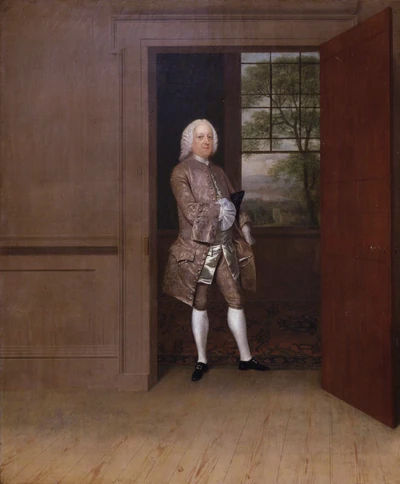
In 1751, Thomas Penn married Lady Juliana Fermor, daughter of Thomas Fermor, 1st Earl of Pomfret. The couple had seven children: four sons and three daughters. Penn commissioned portraits of himself and his wife by Arthur Devis around the time of their marriage. Although born into a Quaker family, Penn gradually distanced himself from the faith, a change confirmed by his marriage in the Church of England.
Thomas Penn died on 21 March 1775 at Stoke Park, Buckinghamshire.