Henrietta Frances De Grey
| Name | Henrietta Frances De Grey |
| Title | Anglo-Irish political hostess and philanthropist (1784-1848) |
| Gender | Female |
| Birthday | 1784-06-22 |
| nationality | Q57695350 |
| Source | https://www.wikidata.org/wiki/Q75271060 |
| pptrace | View Family Tree |
| LastUpdate | 2025-11-26T23:26:56.990Z |
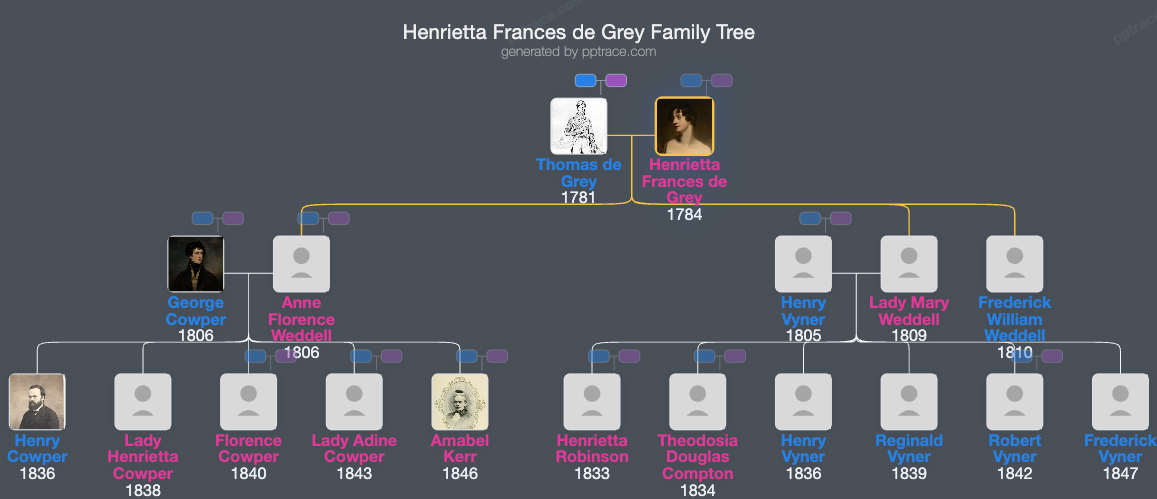
Family Tree
Tap  to expand more relatives
Introduction
Henrietta Frances de Grey, Countess de Grey (born Henrietta Frances Cole), was born on 22 June 1784 at Florence Court in County Fermanagh, Ireland. She was the youngest of ten children of William Cole, 1st Earl of Enniskillen, and his wife Anne Lowry-Corry, daughter of Galbraith Lowry-Corry. Her maternal uncle was Armar Lowry-Corry, 1st Earl Belmore. Henrietta received a well-rounded education, evidenced by her early correspondence. Beginning in 1802, she attended the viceregal court at Dublin Castle. That same year, her mother became ill, and her father entrusted her with managing the household at Florence Court.
In September 1803, Henrietta met Thomas Weddell de Grey. Their engagement was announced in 1805, with proposals made on 23 June 1805, and their marriage occurring on 20 July 1805 in Cobham, Surrey, at the estate of Henry Luttrell, 2nd Earl of Carhampton. Their honeymoon included stays at her husband's residences at Putney and the Newby estate. Their relationship was characterized by mutual respect, as reflected in their correspondence.
Henrietta and Thomas de Grey had five children. Of these, only two daughters survived to adulthood:
- Anne Florence de Grey (8 June 1806 – 25 July 1880), who married George Cowper, 6th Earl Cowper, and inherited the title of suo jure Baroness Lucas from her father Thomas Philip (born 21 August 1807, died 30 March 1810).
- Mary Gertrude de Grey (5 February 1809 – 11 July 1892).
Their two sons, Frederick William (11 April 1810 – 6 February 1831) and Anabel Elizabeth (11 October 1816 – 13 September 1827), died early, and these losses affected Henrietta throughout her life.
In her private life, Henrietta was known for her engagement in political discussions and social events. She often participated in conversations about politics after dinner in the library, especially because her husband did not smoke and she preferred not to retire immediately after meals. She cultivated a significant influence with senior politicians, notably developing a close, platonic friendship with Sir Robert Peel. Through their correspondence, Peel confided in her regarding his frustrations and opinions on religious and political matters, which he did not share with other colleagues. She warned Peel about the approaching "bedchamber crisis" in 1839, a private insight that contributed to Peel's successful negotiation and subsequent government formation in 1841.
In 1841, her husband accepted Peel's invitation to serve as Lord Lieutenant of Ireland, a position she opposed initially due to her desire to remain at Wrest Park and in English society. Nonetheless, she supported her husband in his role, often accompanying him, as recorded in period newspapers. She attended the viceregal court in Dublin and hosted large levees, including one in November 1841 that was the largest since King George IV's visit in 1821. These events aimed to foster community unity and dissuade Protestant marches in response to Repeal movements.
An active philanthropist, Lady de Grey proposed public works funded from royal estates to increase employment in Ireland and schemes to promote native industries in Dublin. She maintained that she did not share Orange political views, nor did she influence her husband's opinions toward Orange sentiments, contrary to some contemporaneous reports.
Following her husband's declining health in 1844, Henrietta managed his political correspondence and played a role in negotiations surrounding his retirement and the appointment of William à Court, 1st Baron Heytesbury, as his successor. After her husband's retirement, she continued her support for Peel's policies, including the increase of the Maynooth Grant. She expressed reservations regarding the repeal of the Corn Laws, attributing the Irish famine to a lack of money rather than food shortages.
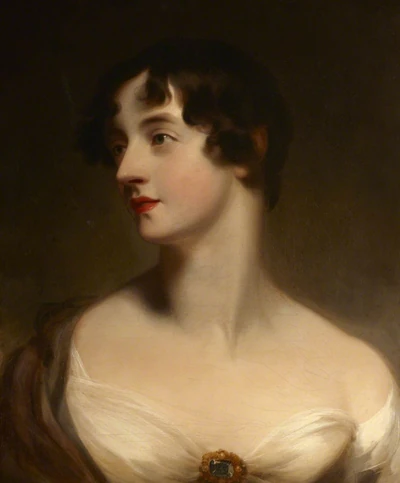
Lady de Grey's health deteriorated in early 1848. She died on 2 July 1848 at 4 St James's Square, London, from cancer. She is buried in the De Grey Mausoleum, with a tomb sculpted by Terence Farrell. Portraits of her are held at Florence Court, the National Portrait Gallery in London, and the National Gallery of Ireland.