Kōki Hirota
| Name | Kōki Hirota |
| Title | Japanese politician executed (1878-1948) |
| Gender | Male |
| Birthday | 1878-02-14 |
| nationality | Japan |
| Source | https://www.wikidata.org/wiki/Q351652 |
| pptrace | View Family Tree |
| LastUpdate | 2025-11-17T10:08:47.476Z |
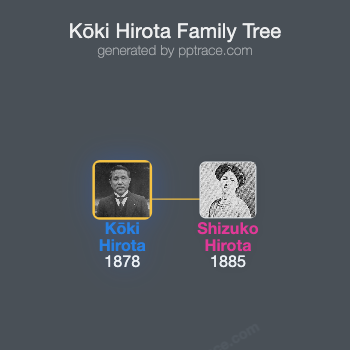
Family Tree
Tap  to expand more relatives
Introduction
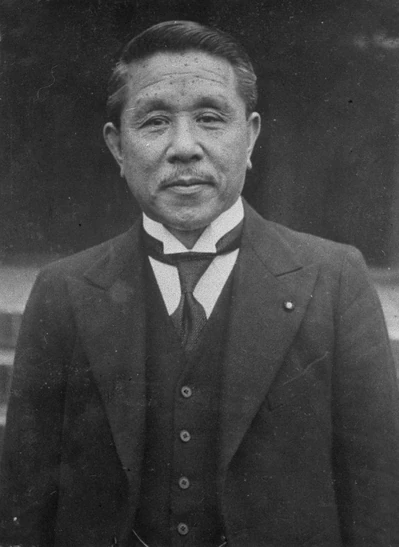
Kōki Hirota (廣田 弘毅, Hirota Kōki), born Jōtarō Hirota on February 14, 1878, in Kaji-machi dori, currently part of Chūō-ku, Fukuoka, Fukuoka Prefecture, Japan, was a Japanese diplomat and politician. He was the son of Hirota Tokubei, a stonemason who was adopted into the Hirota family. His mother was Take, a daughter of the president of a Japanese noodle company. Hirota's early writing talent was recognized when he inscribed the nameplate of a torii gate at Suikyo Shrine at age 11.
He attended Shuyukan school and continued his education at Tokyo Imperial University, earning a degree in law. Among his classmates was Shigeru Yoshida, who would later become Prime Minister of Japan.
Hirota began his career in the Ministry of Foreign Affairs after graduation, serving in various overseas posts. In 1923, he became the director of the Europe and America Department of the Foreign Ministry. He served as Japan’s minister to the Netherlands and later as ambassador to the Soviet Union from 1928 to 1932. In 1933, he was appointed as Japan's Foreign Minister under Prime Minister Saitō Makoto, shortly after Japan's withdrawal from the League of Nations. He continued in this role under Prime Minister Keisuke Okada.
As Foreign Minister, Hirota negotiated the purchase of the Chinese Eastern Railway in Manchuria from Soviet interests. He promulgated the "Hirota Sangensoku" (Three Principles by Hirota) on October 28, 1935, which articulated Japan’s strategic positions regarding China and aimed to establish a Japan–China–Manchukuo bloc, counter the spread of communism, and suppress anti-Japanese activities within China. He characterized regional conflict as a form of "heroic surgery" rather than invasion.
In 1936, Hirota succeeded Keisuke Okada as Prime Minister of Japan, following the discrediting of radical military factions after the February 26 incident. During his premiership, he worked to placate the military, reinstating the system whereby only active-duty Army or Navy officers could serve as war or navy ministers. His administration signed the Anti-Comintern Pact with Nazi Germany and Fascist Italy, a precursor to the Tripartite Pact of 1940. Hirota’s term lasted less than a year; he resigned after a disagreement with War Minister Hisaichi Terauchi over a speech criticizing military interference. Kazushige Ugaki succeeded him but was unable to form a government due to military opposition, leading to the appointment of Senjūrō Hayashi as his replacement in February 1937.
Hirota resumed diplomatic service as Foreign Minister under Prime Minister Fumimaro Konoe. During this second term, he voiced opposition to Japanese military aggression against China and criticized the escalation of the Second Sino-Japanese War, which led to his forced retirement in 1938 due to military dissatisfaction with his criticisms.
In 1945, Hirota participated in Japanese peace negotiations with the Soviet Union, which was still under a non-aggression pact with Japan at the time. Despite initial efforts to prevent Soviet involvement in the Pacific War, the Soviet Union declared war on Japan between the atomic bombings of Hiroshima and Nagasaki.
Following Japan’s surrender in World War II, Hirota was arrested and tried as a Class A war criminal at the International Military Tribunal for the Far East (IMTFE). He faced charges including waging wars of aggression and unprovoked war against China, deriving from Japan’s military actions during the Second Sino-Japanese War. Hirota did not present a defense and was convicted of multiple charges. He was sentenced to death by hanging and executed at Sugamo Prison on December 23, 1948.
Hirota was the only civilian among the condemned at the Tokyo Trials, and his severity has been a subject of historical debate. Reports indicate that as Foreign Minister, he received regular intelligence on military atrocities such as the Nanjing Massacre but lacked authority over military units involved. There was also public support for reducing his sentence, with petitions gathering nearly 30,000 signatures in Japan.
He was awarded the Grand Cordon of the Order of the Sacred Treasure in 1933 and the Grand Cordon of the Order of the Rising Sun in 1934. Hirota’s life and career have been documented in multiple sources, including works by Richard B. Frank, Timothy P. Maga, Richard H. Minear, and John Toland, as well as official trial transcripts.