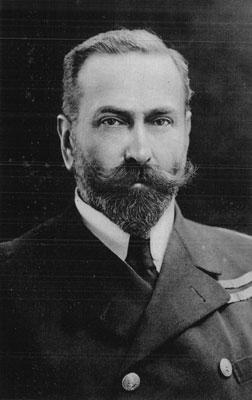
Prince Louis Of Battenberg
| Name | Prince Louis Of Battenberg |
| Title | Nobleman and naval officer (1854–1921) |
| Gender | Male |
| Birthday | 1854-05-24 |
| nationality | Germany |
| Source | https://www.wikidata.org/wiki/Q57468 |
| pptrace | View Family Tree |
| LastUpdate | 2025-11-12T01:19:24.545Z |
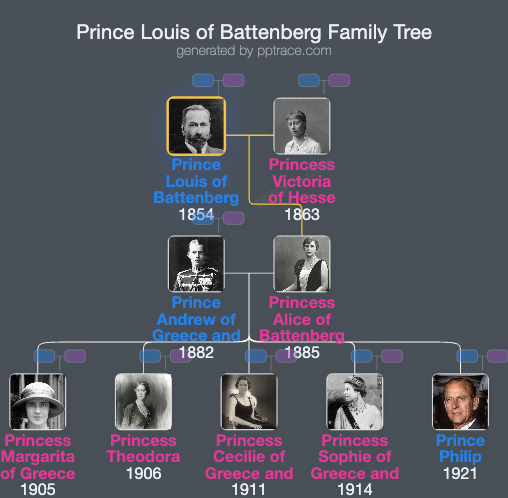
Family Tree
Tap  to expand more relatives
Introduction
Louis Alexander Mountbatten, 1st Marquess of Milford Haven (24 May 1854 – 11 September 1921), was a British naval officer and a member of the German princely family, born as Prince Louis Alexander of Battenberg. His parents were Prince Alexander of Hesse and by Rhine and Countess Julia von Hauke; due to his mother's morganatic marriage, he did not inherit his father's full Hessian rank, instead receiving the style of Count of Battenberg from his maternal lineage.
He was born in Graz, Austria, and spent his early childhood in Italy and Hesse, at the castles of Heiligenberg and Darmstadt. He was raised trilingually—speaking French, German, and English—being influenced by family relations with the Russian imperial family and the Queen Victoria of the United Kingdom. His upbringing included visits from notable relatives and foreign dignitaries.
At the age of fourteen, on 3 October 1868, Battenberg joined the Royal Navy, despite some medical concerns regarding his fitness. He served aboard the HMS Victory and participated in notable voyages alongside the Prince of Wales, including cruises in the Mediterranean, Black Sea, and Egypt, also receiving Ottoman honors such as the Order of the Medjidie and the Order of Osmanieh.
Battenberg married Princess Victoria of Hesse and by Rhine on 30 April 1884. She was the eldest daughter of Princess Alice and Prince Louis IV of Hesse. They had four children: Alice, Louise, George, and Louis. Louise later became Queen of Sweden, and Louis served in the Royal Navy, notably as First Sea Lord from 1954 to 1959. His grandson through his daughter Alice was Prince Philip, Duke of Edinburgh.
Throughout his naval career, Battenberg advanced through ranks, from midshipman in 1869 to captain in 1891, then to rear admiral in 1904, and vice-admiral in 1907. He held command positions, contributed to naval technology development, and served as assistant director of Naval Intelligence. He invented the Battenberg Course Indicator and was an aide-de-camp to Queen Victoria and subsequent monarchs.
He held various senior naval commands, including commander of the Atlantic Fleet and Second-in-Command of the Mediterranean Fleet. He became Second Sea Lord in December 1911, and in December 1912, was appointed First Sea Lord, the head of the Royal Navy. His tenure coincided with significant naval strategic decisions, including the cancellation of fleet dispersal before WWI and the preparation of the fleet for war.
In August 1914, Battenberg signed the convention with France defining naval responsibilities during the war. Due to increasing anti-German sentiment in Britain and the influence of figures like Churchill and Beresford, he resigned as First Sea Lord on 27 October 1914. The government and public expressed support for him following his resignation, which was officially announced in November.
In 1917, at the urging of King George V amidst wartime anti-German sentiment, Battenberg relinquished his German titles and the princely style. He adopted the surname Mountbatten, from his mother's family, and was created Marquess of Milford Haven, Earl of Medina, and Viscount Alderney. His wife and children also adopted British titles, with his son Louis later becoming Lord Louis Mountbatten.
After the war, he retired from active service but continued writing on naval topics, including a notable encyclopedia on medals. During the post-war period, financial hardships led to the sale of properties and collection of medals. He was promoted to full admiral of the fleet in 1921 and received various honors, including being appointed a Knight Grand Cross of the Order of the Bath.
He died at his residence in London on 11 September 1921, succumbed to heart failure following influenza, and was buried at St. Mildred's Church, Whippingham, on the Isle of Wight. His legacy includes his contributions to naval strategy, technology, and his family lineage, notably his grandson Prince Philip.