Levi Todd
| Name | Levi Todd |
| Title | Kentucky pioneer and civil servant |
| Gender | Male |
| Birthday | 1756-10-04 |
| nationality | United States of America |
| Source | https://www.wikidata.org/wiki/Q6535535 |
| pptrace | View Family Tree |
| LastUpdate | 2025-11-16T10:13:10.313Z |
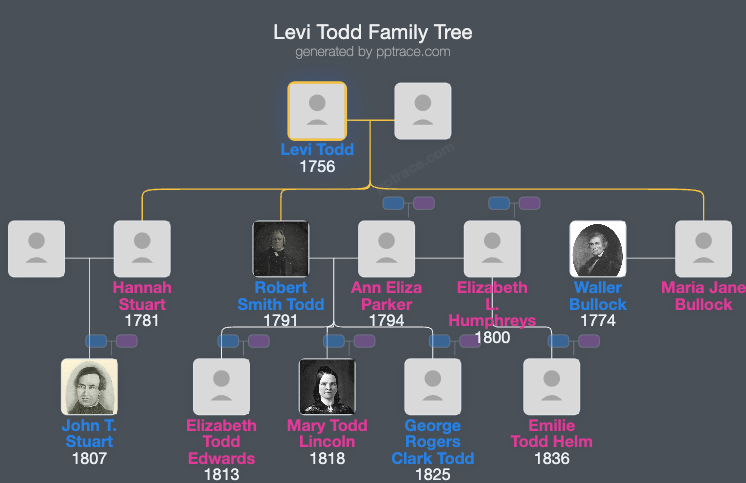
Family Tree
Tap  to expand more relatives
Introduction
Levi Todd (October 4, 1756 – September 6, 1807) was an American pioneer and early settler of Kentucky. He was instrumental in the founding of present-day Lexington, Kentucky, alongside his brothers John and Robert Todd. Prior to Kentucky's admission into the United States in 1792, the Todd family established themselves as prominent landowners and political figures within the state.
Levi Todd was born in Virginia, the youngest son of David Todd and Hannah Owen. He received his early education in Louisa County, Virginia, and studied law under General Andrew Lewis. In 1775, he relocated to Kentucky with his brothers, arriving with John Floyd to establish Lexington. Following the construction of the settlement’s stockade walls, Todd was elected as one of four Gentlemen Trustees in March 1776. Over the subsequent year, he contributed to plans for building and expanding the settlement.
In 1777, Levi Todd was appointed the first clerk of Kentucky County. During the American Revolutionary War, he served alongside his brothers in the western theater, under General George Rogers Clark during the Illinois campaign. He participated in the capture of Kaskaskia in 1778 and was involved in the detention of British agent Philippe-François de Rocheblave, whom he escorted to Virginia as a prisoner-of-war. For his military service, Todd was awarded 2,156 acres of land at Clark's Grant.
Todd married Jane Briggs on February 25, 1779, at St. Asaphs Fort in Lincoln County; the couple had eleven children. He was active militarily, leading a militia company during Colonel John Bowman’s expedition against the Shawnee town of Chillicothe, and later became a farmer and lawyer. He accumulated land, purchasing strips from veterans in lieu of payment from the federal government, which eventually expanded his holdings to a plantation spanning three counties. In 1779, he founded Todd's Station on South Elkhorn Creek but later moved to Lexington due to Indian threats.
In 1780, Todd was appointed Fayette County court clerk by Governor Isaac Shelby, a position he held until his death. His duties included managing property records, issuing marriage licenses, and maintaining deeds and mortgages. He was also a trustee of Transylvania University and became one of Lexington’s earliest landholders when city plans were adopted in December 1781. In 1782, he was part of the town's trustee board.
In August 1782, Todd led a militia force after reports of raids by British Captain William Caldwell and allied Native American fighters. The subsequent engagement at Bryan's Station saw Todd's forces unable to prevent Caldwell’s destruction of crops and livestock outside Lexington. Levi Todd competed in the Battle of Blue Licks, where his brother John Todd was killed. He authored the first contemporary account of the battle at his brother Robert Todd’s direction; this account is notable for its accuracy, and he later published a detailed report including eyewitness testimonies.
Levi Todd advanced to become a major general, succeeding Daniel Boone as militia commander. He represented Kentucky at several conventions advocating for statehood, participating in meetings in Danville in 1785 and 1787.
In 1787, Todd constructed the first brick house in Fayette County, located outside Lexington on Richmond Pike. Named after the Scottish village Ellerslie, the estate was expanded from a small two-story structure into a large villa with numerous outbuildings, including a stone round house for records storage. In 1801, he donated land for Walnut Hill Presbyterian Church, the oldest Presbyterian church in Fayette County.
In 1803, Todd’s estate was targeted by angry tenants and squatters protesting property rights; while his estate was spared, his office was burned, leading to the destruction of many early records. At his death in 1807, Levi Todd owned 7,000 acres in Fayette and Franklin counties, valued at over $6,000. His possessions included silverware, fine china, a personal library with works by Mary Wollstonecraft, Edmund Burke, and William Blackstone, as well as twenty-one slaves, horses, livestock, and a carriage.
He was buried in Lexington Cemetery. His family estate was inherited by his son Robert S. Todd and later sold to the Lexington Water Company, with the house demolished in 1947.