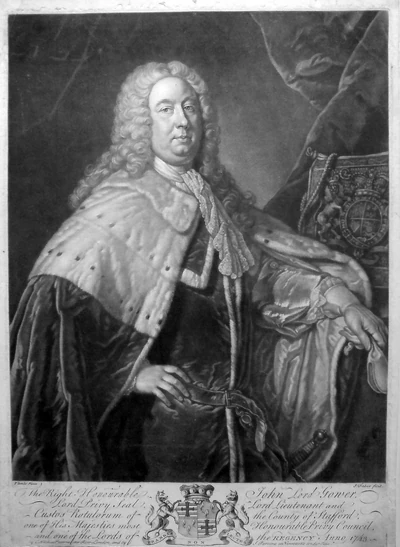
John Leveson-Gower, 1st Earl Gower
| Name | John Leveson-Gower, 1st Earl Gower |
| Title | British politician (1694-1754) |
| Gender | Male |
| Birthday | 1694-08-10 |
| nationality | Great Britain |
| Source | https://www.wikidata.org/wiki/Q336200 |
| pptrace | View Family Tree |
| LastUpdate | 2025-11-26T23:25:17.803Z |
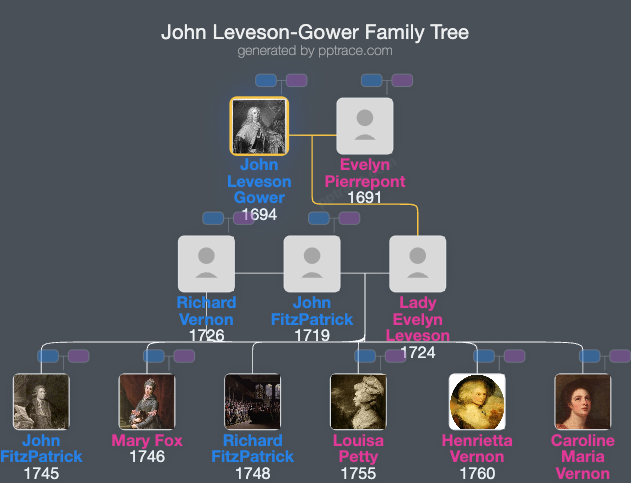
Family Tree
Tap  to expand more relatives
Introduction
John Leveson-Gower, 1st Earl Gower, PC (10 August 1694 – 25 December 1754), was a British politician associated with the Tory and subsequent Whig parties. He was born in London, England, into the aristocratic Leveson-Gower family. His father was John Leveson-Gower, who served in the House of Commons before being elevated to the peerage as Baron Gower in 1703; his mother was Lady Catherine Manners, daughter of the 1st Duke of Rutland.
Leveson-Gower received education at Westminster School and matriculated at Christ Church, Oxford, in 1710. Following his father’s death in 1709, he inherited his peerage as Baron Gower and took his seat in the House of Lords. During his early years, he was inclined toward Jacobitism but did not participate actively in politics, instead engaging in fox hunting and horse racing. By the late 1720s, he had established a political support base in Staffordshire, controlling four parliamentary boroughs: Newcastle-under-Lyme, Stafford, Lichfield, and Cheadle. He also served as the mayor of Cheadle in 1721.
In 1740, Leveson-Gower was appointed as a Lord Justice and, following the collapse of the Walpole ministry in 1742, became Lord Privy Seal, the only Tory to hold such a position during that period. He was appointed to the Privy Council on 12 May 1742 under the Carteret ministry. His political activities included switching allegiance from Tory to Whig, which led to his resignation from the Lord Privy Seal in December 1743, but he was reappointed in 1744 as part of the Whig-led Broad Bottom ministry under Henry Pelham and the Duke of Newcastle.
Leveson-Gower demonstrated loyalty during the Jacobite rising of 1745 by affirming his allegiance to King George II and raising a British regiment to oppose the Jacobite invasion. For his support, he was granted the titles of Viscount Trentham and Earl Gower on 8 July 1746. During the 1747 general election, he faced contestation of his support base; despite extensive campaign efforts and substantial expenditure, he retained only two of the seven contested constituencies: Stafford and Lichfield.
Throughout his later years, Leveson-Gower continued to serve as Lord Privy Seal, being reappointed in 1750 and 1752. He refused to resign in 1751 and 1754 despite mounting opposition and criticism, including mention in Samuel Johnson’s "A Dictionary of the English Language" under the term "renegado." His political loyalty was aligned with the Pelham ministry, and he was associated with the so-called "Pelhamites," a faction supportive of the Whig government.
Leveson-Gower died on 25 December 1754 at his London residence, 6 Upper Brook Street. His titles were inherited by his son Granville; the office of Lord Privy Seal was succeeded by Charles Spencer, 3rd Duke of Marlborough. His death was noted by Mary Delany, who recorded that women mourning his passing wore only grey or white clothing for a week, in accordance with mourning customs.
He inherited the Trentham Estate and constructed Trentham Hall on the property in 1730, designed after Buckingham House. The estate and his political support were financed in part through investments in Britain’s industrial sectors and shares in various estates. By his death, his financial estate was heavily encumbered, with debts of £37,861 and legacies amounting to approximately £36,000 (equivalent to about £6.9 million in 2023).
Leveson-Gower was married three times. His first marriage was to Lady Evelyn Pierrepont on 13 March 1712, the daughter of the 1st Duke of Kingston-upon-Hull; she died on 26 June 1727, shortly after the birth of their twelfth child.