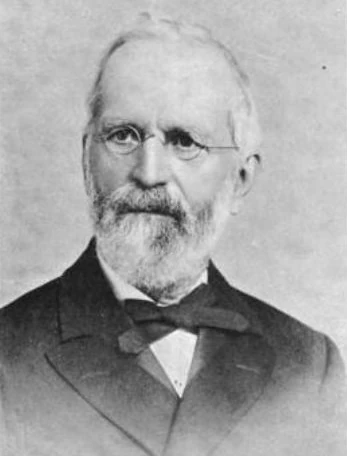
Stephen Wright Kellogg
| Name | Stephen Wright Kellogg |
| Title | American politician (1822-1904) |
| Gender | Male |
| Birthday | 1822-04-05 |
| nationality | United States of America |
| Source | https://www.wikidata.org/wiki/Q657191 |
| pptrace | View Family Tree |
| LastUpdate | 2025-11-17T06:42:53.264Z |
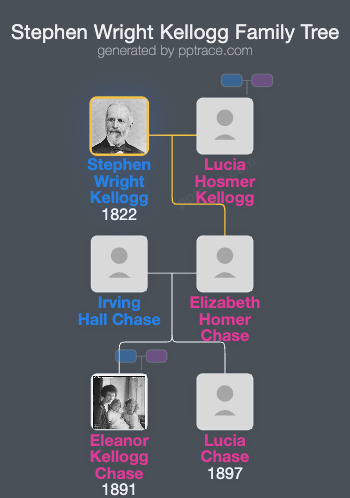
Family Tree
Tap  to expand more relatives
Introduction
Stephen Wright Kellogg was born on April 5, 1822, in Shelburne, Massachusetts. He worked on his father's farm until the age of twenty, during which time he also attended or taught school during the winter months. In the fall of 1842, he began his college education at Amherst College, but he only remained there for two terms. Subsequently, he enrolled at Yale College as part of the class of 1846. During his time at Yale, he was a member of the secret society Skull and Bones and graduated with highest honors. One of his classmates and fellow members of Skull and Bones was Henry Baldwin Harrison, who later became a notable figure and remained a lifelong friend.
Following his graduation from Yale College, Kellogg pursued a brief period of school teaching before enrolling in Yale Law School. He was admitted to the bar in June 1848. His legal career began in Naugatuck, Connecticut, where he practiced law until 1854. In that year, he was elected judge of probate for the district of Waterbury and moved to Waterbury, which was then a small city. He served as probate judge for seven years.
In 1854, Kellogg was appointed judge of the New Haven County Court by the legislature. Beyond his judicial appointments, he held several public offices and was actively involved in politics. From 1851, he served as clerk of the Connecticut State Senate. He was a member of the Connecticut State Senate in 1853 and served in the Connecticut House of Representatives in 1856. Kellogg was also a delegate to the Republican National Conventions in 1860, 1868, and 1876.
He was elected to the United States Congress three times from Connecticut's second district, which was predominantly Democratic. Despite the district's political leanings, his persistence and effort in representing his constituents resulted in notable success. In the 1875 election, Kellogg was defeated in his bid for re-election by James Phelps, but he garnered over 45% of the vote in that election.
During the American Civil War, Kellogg served in the military as colonel of the Second Regiment of the Connecticut National Guard from 1863 to 1866. After the war, he was promoted to Brigadier-General, serving from 1866 to 1870. He was instrumental in organizing the Connecticut National Guard into an effective militia force through legislation he authored and promoted.
Throughout his life, Kellogg remained engaged in public affairs and continued to contribute through both voice and writings until shortly before his death. He died on January 27, 1904, in Waterbury, Connecticut, at the age of 81. He was interred at Riverside Cemetery.