Alexander Bryan Johnson
| Name | Alexander Bryan Johnson |
| Title | United States philosopher and banker |
| Gender | Male |
| Birthday | 1786-05-29 |
| nationality | United States of America |
| Source | https://www.wikidata.org/wiki/Q4718454 |
| pptrace | View Family Tree |
| LastUpdate | 2025-11-17T06:37:07.520Z |
Family Tree
Tap  to expand more relatives
Introduction
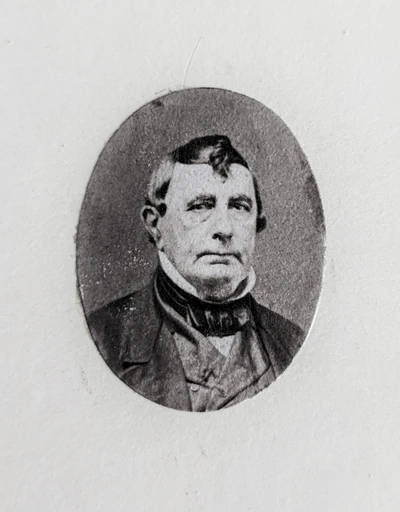
Alexander Bryan Johnson (May 29, 1786 – September 9, 1867) was a philosopher and semanticist born in Gosport, Hampshire, England. He emigrated to the United States at age 16 and settled in Utica, New York. Johnson was of Netherlandic and Jewish descent. His primary occupation was in banking; he worked as a banker in Utica for many years and was also admitted to the bar, though he did not practice law.
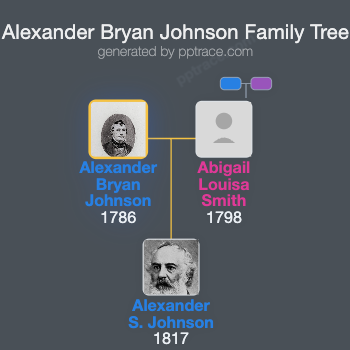
Johnson married Abigail Louisa Smith Adams (1798–1836), who was the daughter of Charles Adams and Sally Smith and the granddaughter of President John Adams and Abigail Adams. They had a son, Alexander Smith Johnson, born in Utica in 1817. His son served as a judge and died in Nassau, Bahamas, in 1878.
Throughout his life, Johnson dedicated time to the study of intellectual philosophy, particularly focusing on the relationship between knowledge and language. His work aimed to determine the ultimate meaning of words independent of their conventional definitions and to understand human knowledge apart from linguistic expression. In 1836, he published "A Treatise on Language," which has been recognized posthumously for its anticipation of concepts later associated with logical positivism, particularly regarding misunderstandings in language and their impact on philosophical inquiry.
Despite his primary career as a banker and financier, Johnson was a prolific author, publishing ten books and numerous political articles, pamphlets, and lectures. His writings covered various topics, including economics, language philosophy, morality, and politics. Some notable publications include "A Treatise on Banking" (1850), "The Philosophy of Joint-Stock Banking" (1851), and "Our Monetary Condition" (1864). Additionally, he authored "Religion in its Relation to the Present Life" (1840), which discussed moral conduct and self-control.
Johnson's philosophy emphasized the importance of language understanding in philosophical discourse. He identified four fallacies embedded in language: the identification of verbally distinct concepts, the assimilation of heterogeneous concepts, the creation of units from multifarious concepts, and the transmutation of untransmutable entities.
His work was largely disregarded during his lifetime but has been recognized in later analyses for its foresight into linguistic and semantic issues. He regarded language as a key domain for understanding human knowledge and morality. His contributions extend beyond philosophy into political and economic thought, reflecting a broad range of interests and a commitment to moral clarity and intellectual development.
Johnson died on September 9, 1867, in Utica, New York, at the age of 81. He was buried in Forest Hill Cemetery in Utica.