Sidney Godolphin, 1st Earl Of Godolphin
| Name | Sidney Godolphin, 1st Earl Of Godolphin |
| Title | British politician (1645-1712) |
| Gender | Male |
| Birthday | 1645-06-15 |
| nationality | Kingdom of England |
| Source | https://www.wikidata.org/wiki/Q947776 |
| pptrace | View Family Tree |
| LastUpdate | 2025-11-26T23:21:43.902Z |
Family Tree
Tap  to expand more relatives
Introduction
Sidney Godolphin, 1st Earl of Godolphin, was born on 15 June 1645 and died on 15 September 1712. He was a British statesman affiliated with the Tory political party. Over his career, he held several significant positions, including Privy Councillor, Secretary of State for the Northern Department, and First Lord of the Treasury. His influence was notably instrumental in the negotiations leading to the Acts of Union 1707 with Scotland, which established the Kingdom of Great Britain. Additionally, he served as Governor of the Scilly Isles.
Family and Early Life:
Sidney Godolphin was from an ancient Cornish family. His father was Sir Francis Godolphin (1605–1667), and he was the nephew of poet Sidney Godolphin. During the Restoration period, he entered the royal household with the support of King Charles II of England, becoming one of the King's favorites. He was also elected to the House of Commons as the Member of Parliament for Helston in Cornwall. Despite his limited speaking during parliamentary sessions, his speeches were concise, earning him a reputation as a key financial authority within the House.
In 1668, Godolphin acted as an intermediary between King Charles II and his sister Henrietta Anne, the Duchess of Orléans, facilitating an agreement with King Louis XIV of France. The deal involved rejecting England's Dutch allies in exchange for financial subsidies. In 1669, he secured a 31-year lease on tin mines in Rialton and Retraigh, Cornwall. He was appointed Groom of the Bedchamber in 1670, a position he held until 1678, and was valued by the King for his unobtrusive service. In 1672, Godolphin was appointed envoy-extraordinary to Louis XIV, aiming to reassure France of Charles II’s allegiance before the Franco-Dutch War. He accompanied Louis XIV during military campaigns but was unimpressed with Louis's military leadership.
Political Career:
Godolphin was appointed to the Privy Council in March 1679 and, alongside Viscount Hyde (later Earl of Rochester) and the Earl of Sunderland, took part in managing state affairs. Although he voted for the Exclusion Bill of 1680, which sought to prevent James, Duke of York, from ascending the throne due to his Catholic faith, he maintained his political roles afterward. In September 1684, he was created Baron Godolphin of Rialton and succeeded Rochester as First Lord of the Treasury.
During James II's reign, Godolphin served as chamberlain to Queen Mary of Modena and was one of the king's trusted ministers. In 1687, he became a commissioner of the treasury. He was involved in secret payments from France to James II, receiving around £125,000 in return for support, a practice viewed critically by historians but not uncommon at the time. He was present at the birth of James Francis Edward Stuart, known as the Old Pretender, and diplomatically declined to comment on the controversy surrounding the legitimacy of the birth.
After James II's abdication and the accession of William III, Godolphin continued to influence government affairs. Initially holding the third seat at the treasury board, he retired in March 1690 but was recalled in November of the same year, then reaffirmed his role as First Lord of the Treasury.
Under William III and Queen Anne:
During William III’s reign, Godolphin engaged in secret correspondences with James II, including sharing intelligence about military expeditions. His political allegiance remained Tory, and he was closely associated with the Tory faction's interests. After some political setbacks, he was appointed First Lord of the Treasury again in 1700, serving in that capacity for several years. Queen Anne appointed him Lord Treasurer following Marlborough's recommendation, although he was not considered a formal favorite of the Queen.
In 1704, Godolphin was appointed a Knight of the Garter, and in December 1706, he was elevated to Viscount Rialton and Earl of Godolphin. His political influence extended to involvement in the alliance shifts between Tories and Whigs, often acting as a key figure alongside John Churchill, the future Duke of Marlborough, in the governance of the era.
Relationship with Queen Anne and Later Years:
Initially, Queen Anne relied heavily on Godolphin's advice, but their relationship later became strained, especially after political conflicts involving Marlborough and other courtiers. In 1710, amidst political upheaval, Queen Anne dismissed him from office. He died in 1712, leaving an estate valued at over £12,000. Godolphin was buried in Westminster Abbey, where a bust by Francis Bird commemorates him.
Marriage and Children:
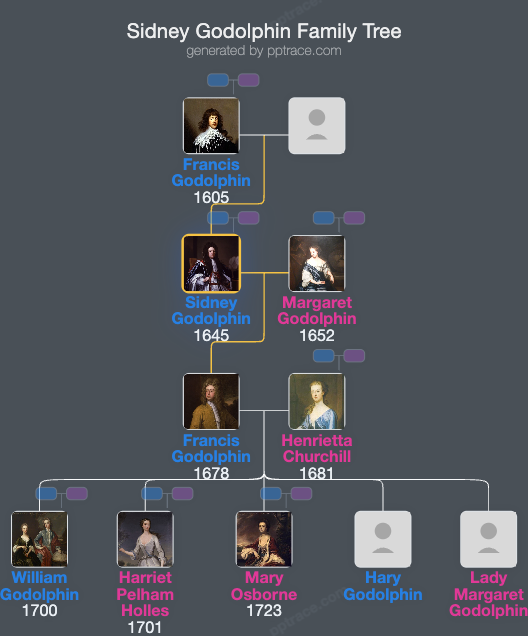
Godolphin married Margaret Blagge on 16 May 1675. She was the daughter of Thomas Blagge, and her life was documented by John Evelyn. Margaret died in childbirth in 1678, and they had a son, Francis Godolphin, who became the 2nd Earl of Godolphin. Godolphin did not remarry.
Legacy:
Sidney Godolphin was recognized for his competence in finance and administration. His career exemplified a capacity to serve different political administrations, maintaining influence through periods of change. His role in key political and military negotiations during the late 17th and early 18th centuries marked him as a significant figure in British history.