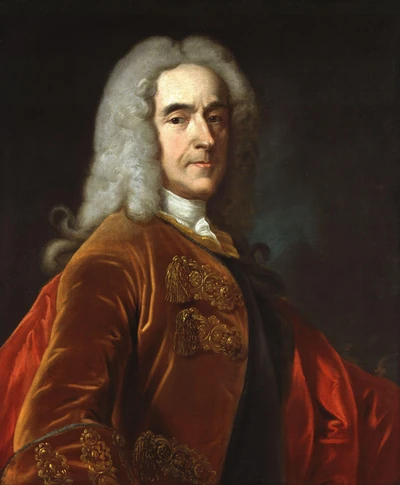
Richard Temple, 1st Viscount Cobham
| Name | Richard Temple, 1st Viscount Cobham |
| Title | British soldier and Whig politician (1675-1749) |
| Gender | Male |
| Birthday | 1675-10-24 |
| nationality | Great Britain |
| Source | https://www.wikidata.org/wiki/Q2072512 |
| pptrace | View Family Tree |
| LastUpdate | 2025-11-26T23:25:48.683Z |
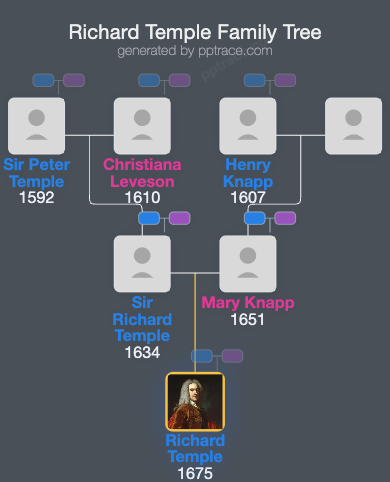
Family Tree
Tap  to expand more relatives
Introduction
Field Marshal Richard Temple, 1st Viscount Cobham (24 October 1675 – 14 September 1749), was a British military officer and politician affiliated with the Whig party. He was born in England and was the son of Sir Richard Temple, 3rd Baronet, and his wife Mary Temple (née Knapp), daughter of Thomas Knapp. Temple received education at Eton College and Christ's College, Cambridge.
He was commissioned as an ensign in Prince George of Denmark's Regiment on 30 June 1685. By 1689, he held the rank of captain in Babington's Regiment. Temple participated in the Williamite War in Ireland under William III against the Jacobite Irish Army of James II. He was present at the Siege of Namur in July 1695 during the Nine Years' War. In May 1697, he succeeded his father as the 4th Baronet and was elected Member of Parliament for Buckingham the same year, a position he held for approximately 16 years.
On 10 February 1702, Temple was promoted to lieutenant colonel and was given command of his own regiment. During the War of the Spanish Succession, he served under John Churchill, 1st Duke of Marlborough, at key battles including Venlo (September 1702), Roermond (October 1702), Oudenarde (July 1708), and the Siege of Lille (Autumn 1708). He was commended for his conduct at Lille and was sent to present dispatches to Queen Anne. He supported the Whig party’s policies and voted for the Foreign Protestants Naturalization Act of 1708.
He rose to the rank of major-general on 1 January 1709 and fought at the Battle of Malplaquet in September 1709. He was promoted to lieutenant general on 1 January 1710. In Parliament, he supported the impeachment of Henry Sacheverell in 1710. That year, he was appointed colonel of the Princess Anne of Denmark's Regiment of Dragoons. Starting in 1711, he extensively renovated his estate at Stowe, working with architect John Vanbrugh and gardener Charles Bridgeman.
Temple was stripped of his colonelcy in 1713 for opposing the Treaty of Utrecht but was appointed ambassador to Vienna after George I’s accession in 1714. He was created Baron Cobham in October 1714 and later elevated to Viscount Cobham in April 1718. During this period, he served as colonel of The Royal Regiment of Dragoons (1715), Governor of Jersey (from May 1723), and Lord Lieutenant of Buckinghamshire (from March 1728). He was made a Privy Councillor in July 1716.
He became a mentor and political supporter to William Pitt, who was among a group of young Whigs known as Cobham's Cubs. Two of these protégés, William Pitt and George Grenville, later became Prime Ministers. In 1719, during the War of the Quadruple Alliance, Temple led a raid on the Spanish coast, capturing Vigo and occupying it for ten days before withdrawing.
After Sir Robert Walpole's accession to power in 1721, Temple generally supported the government and was rewarded with the colonelcy of the King's Own Regiment of Horse. He served as Governor of Jersey and as Lord Lieutenant of Buckinghamshire. His opposition to Walpole led to his falling out with the prime minister in 1733 and to the loss of his colonelcy. He was promoted to full general on 27 October 1735.
He continued his military and political career, supporting William Pitt and fellow Whigs. On 10 July 1742, he was promoted to field marshal, and on the same day, he became colonel of the 1st Troop of Horse Grenadier Guards. He later held colonelcy of Viscount Cobham's Regiment of Horse (1744) and of Viscount Cobham's Regiment of Dragoons (June 1745). Temple died at Stowe on 13 September 1749 and was buried there.
In his personal life, Temple married Anne Halsey, daughter of Edmund Halsey of the Anchor Brewery, in September 1715. The marriage produced no surviving children, though they had a daughter, Elizabeth, born in 1738 and baptized at Westminster; she died shortly before her fourth birthday in 1742. After Temple’s death, arrangements were made with distant relatives, with Hester Grenville, Temple’s sister, and her son inheriting the family estates and the title of 2nd Viscount Cobham.
Temple's gardens and estate at Stowe gained acclaim, including praise from poet Alexander Pope, who wrote in his "Epistle to Burlington" and "An Epistle to the Right Honourable Richard Lord Visct. Cobham."