Leo Amery
| Name | Leo Amery |
| Title | politician and journalist (1873-1955) |
| Gender | Male |
| Birthday | 1873-11-22 |
| nationality | United Kingdom |
| Source | https://www.wikidata.org/wiki/Q333573 |
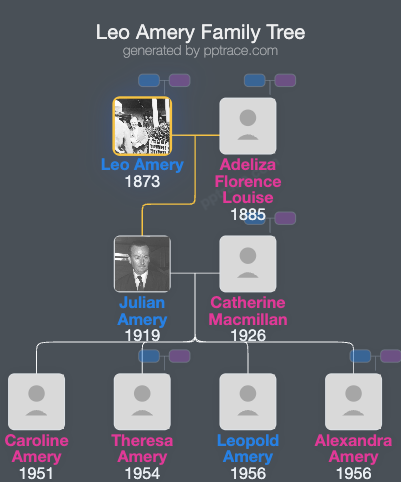
| pptrace | View Family Tree |
| LastUpdate | 2025-11-26T23:33:17.769Z |
Family Tree
Tap  to expand more relatives
Introduction
Leopold Charles Maurice Stennett Amery (22 November 1873 – 16 September 1955), commonly known as L. S. Amery, was a British Conservative Party politician and journalist. His career was characterized by a focus on military preparedness, the British Empire, and opposition to appeasement policies. Amery served as Secretary of State for the Colonies from 1924 to 1929 and as Secretary of State for India during World War II, from 1940 to 1945. He was also known for his extensive writings, which included a multi-volume history of the Second Boer War, autobiographical volumes, and diaries published posthumously. His speech in the House of Commons on 7 May 1940 during the Norway Debate, attacking Prime Minister Neville Chamberlain's handling of the war effort, is often noted for its impact on British political history, contributing to Chamberlain's resignation and Churchill’s subsequent appointment as Prime Minister.
Amery was born in Gorakhpur, British India, the son of Charles Frederick Amery, an officer in the Indian Forestry Commission, and Elisabeth Johanna Saphir, who was of Hungarian Jewish descent and the sister of orientalist Gottlieb Wilhelm Leitner. His father was of Lustleigh, Devon. In 1877, his mother relocated to England, and in 1885, she divorced Charles Frederick Amery.
He attended Harrow School starting in 1887, where he excelled academically, participated in gymnastics, won prizes, and scholarships. At Harrow, he was a contemporary of Winston Churchill, with whom he had a notable incident involving a mistaken identity. After Harrow, Amery studied at Balliol College, Oxford, earning a double first class in Classical Moderations in 1894 and in literae humaniores in 1896. He was a proxime accessit for the Craven scholarship and an Ouseley scholar in Turkish. During his time at Oxford, he was elected a fellow of All Souls College and became proficient in multiple languages, including Hindi, French, German, Italian, Bulgarian, Turkish, Serbian, and Hungarian.
In addition to his academic pursuits, Amery was an active freemason and a keen sportsman, particularly mountaineering and skiing. He was president of the Alpine Club from 1943 to 1945 and was a member of notable clubs such as the Athenaeum and Carlton.
During the Second Boer War, Amery worked as a correspondent for The Times, where he notably criticized Commander Sir Redvers Buller, and was the only correspondent to visit Boer forces. Following the war, he contributed to the published history of the conflict and authored works on military reorganization, notably *The Problem of the Army* (1903). He also wrote articles under the pseudonym "Tariff Reformer," advocating protectionist policies, and authored *The Fundamental Fallacies of Free Trade* in 1906.
In his political career, Amery initially aligned with the Liberal Unionists, a party allied with the Conservatives, and was elected Member of Parliament (MP) for Birmingham South in 1911. He was an admirer of Joseph Chamberlain and supported tariff reform and imperial federation. He declined to become editor of *The Observer* in 1908 and of *The Times* in 1912 to focus on politics.
Amery married Florence Greenwood in 1910, with whom he had two sons. During World War I, he served as an intelligence officer in the Balkans, utilizing his knowledge of Hungarian. He worked in the war cabinet secretariat under Lloyd George's coalition government and redrafted the Balfour Declaration at Lord Milner's request. He was deeply committed to strategic considerations, advocating for Britain's control of key sea lanes and land routes to India, and the occupation of territories such as Palestine, Mesopotamia, Persia, Arabia, and the Caucasus.
Throughout his political and journalistic career, Amery engaged extensively with issues of imperial strategy, military reform, and foreign policy until his death in 1955.