Mary Arthur McElroy
| Name | Mary Arthur McElroy |
| Title | First Lady of the United States (1841-1917) |
| Gender | Female |
| Birthday | 1841-07-05 |
| nationality | United States of America |
| Source | https://www.wikidata.org/wiki/Q254488 |
| pptrace | View Family Tree |
| LastUpdate | 2025-11-17T06:41:17.064Z |
Family Tree
Tap  to expand more relatives
Introduction
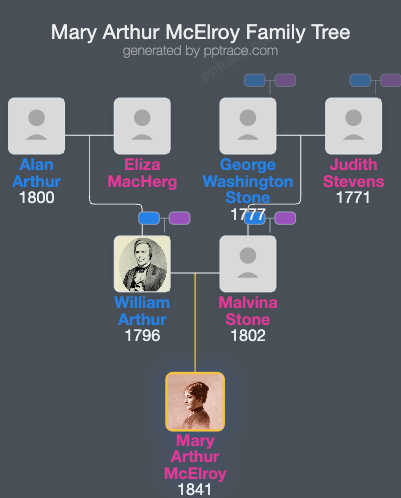
Mary McElroy (née Arthur) was born on July 5, 1841, in Greenwich, New York. She was the youngest of nine children born to William Arthur and Malvina S. Stone. Her mother, Malvina, was born in Vermont and was of primarily English and Welsh descent. Her maternal grandfather, Uriah Stone, served in the Continental Army during the American Revolution. William Arthur, her father, was born in Dreen, County Antrim, Ireland, and emigrated to Canada around 1819 or 1820 after graduating from college in Belfast. He met Malvina in Quebec, where he was teaching prior to their marriage.
Mary Arthur attended the Emma Willard School Seminary in Troy, New York, where she received an education equivalent to that provided in men's schools, studying history, geography, science, and French. She initially intended to become a teacher and worked at a private school in Edgecombe County, North Carolina, before her marriage.
On June 13, 1861, she married John Edward McElroy (1833–1915), an insurance salesman and reverend, the son of William McElroy and Jane Mullen. The couple resided in Albany, New York, and had four children: May (born 1862), William (1864–1892), Jessie (1867–1934), and Charles (1873–1947). Mary also helped raise her brother Chester A. Arthur's children after his wife Nell died in 1880 and was particularly close to his daughter Nellie, encouraging her musical pursuits.
Chester A. Arthur was elected Vice President in 1880 and became the 21st President of the United States following President James A. Garfield's assassination in 1881. In January 1883, President Arthur designated Mary McElroy as White House hostess to fulfill the social duties traditionally carried out by the First Lady, as his wife had passed away nearly two years earlier. Her appointment was partly influenced by her close relationship with Arthur's daughter.
Mary McElroy began her role as acting First Lady on January 24, 1883, participating in a diplomatic dinner and hosting her first reception on January 27. She continued to serve in this capacity during the winter social season, which was subdued due to national mourning. She officially returned to Albany in March but made subsequent visits to the White House, including to participate in New Year's Day celebrations in 1884. During her tenure, she initiated new social customs, such as holding weekly open-house receptions during Lent and serving afternoon tea after White House events.
Though President Arthur, out of respect for his late wife, never officially approved her role as First Lady, McElroy gained recognition for her effective hosting and her personal style. She hosted several notable events, including honoring former First Ladies Julia Tyler and Harriet Lane and organizing a private luncheon for Julia Grant. She also used her increased social freedom to attend events outside the White House and declined involvement in causes or charities, focusing instead on the social functions themselves.
Her final White House reception took place on February 28, 1885, attended by approximately 3,000 guests. She maintained a friendly relationship with her successor, Rose Cleveland, and hosted a farewell luncheon for her during the presidential transition.
After President Arthur’s departure from office, Mary McElroy stayed in Washington for several weeks with him and then returned to Albany. In 1886, she traveled to Ireland to visit family and help preserve the Arthur family homestead as a historic site. Following Chester A. Arthur’s critical illness and subsequent death later that year, McElroy arranged his funeral, managed his presidential legacy, and organized the unveiling of his statue in Madison Square Park. She also became the legal guardian of Arthur’s daughter.
In her later years, McElroy was supportive of civil rights initiatives, hosting Booker T. Washington at her home in 1900. She opposed women’s suffrage and was a member of the Albany Association Opposed to Women’s Suffrage. Mary McElroy died on January 8, 1917, in Albany at the age of 75, and was interred in Albany Rural Cemetery.
Due to her relatively brief time as White House hostess and limited scholarly attention to her life and period, she remains among the lesser-known figures in American presidential history. Nonetheless, historians have recognized her for her hospitality and her adaptability in serving as acting First Lady.