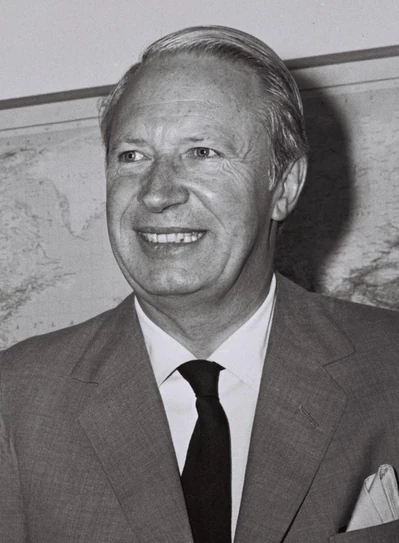
Edward Heath
| Name | Edward Heath |
| Title | Prime Minister of the United Kingdom from 1970 to 1974 |
| Gender | Male |
| Birthday | 1916-07-09 |
| nationality | United Kingdom |
| Source | https://www.wikidata.org/wiki/Q128967 |
| pptrace | View Family Tree |
| LastUpdate | 2025-11-26T23:33:31.568Z |
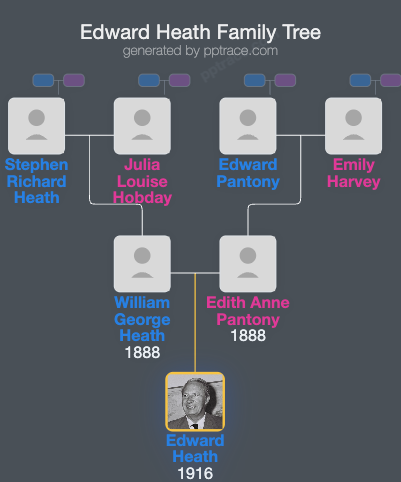
Family Tree
Tap  to expand more relatives
Introduction
Sir Edward Richard George Heath (9 July 1916 – 17 July 2005) was a British politician who served as Prime Minister of the United Kingdom from 1970 to 1974 and as Leader of the Conservative Party from 1965 to 1975. He was a Member of Parliament (MP) for 51 years, serving from 1950 until 2001. Outside of his political career, Heath was engaged in yachting, music, and authorship.
Heath was born at 54 Albion Road, Broadstairs, Kent. His parents were William George Heath (1888–1976), a carpenter and later a builder, and Edith Anne Heath (née Pantony; 1888–1951), a lady’s maid. His paternal grandfather operated a small dairy business and subsequently worked as a porter at Broadstairs Station. Heath had a younger brother named John, born four years after him.
He was educated at Chatham House Grammar School in Ramsgate, Kent. In 1935, with the aid of a county scholarship, he enrolled at Balliol College, Oxford, where he studied Philosophy, Politics, and Economics, graduating in 1939 with a Second Class Honours BA. During his time at Oxford, Heath was active in Conservative student politics. He was elected President of the Oxford University Conservative Association in 1937 and served as chairman of the national Federation of University Conservative Associations during 1937–38. He also held positions such as Secretary and Librarian of the Oxford Union, ultimately serving as its President in November 1938.
Heath was a talented musician, winning an organ scholarship at Balliol College. His early political stance was characterized by opposition to appeasement policies towards Germany and support for anti-fascist causes. He traveled extensively in Europe during his university years, witnessing first-hand the rise of Nazi Germany. His encounters with Nazi leaders, including Hermann Göring, Joseph Goebbels, and Heinrich Himmler, occurred during visits to Germany in the late 1930s.
With the onset of World War II, Heath served as an officer in the Royal Artillery. His wartime service included deployments in various theatres, though specific details are limited in this account.
After the war, Heath briefly worked in the Civil Service before resigning to stand for Parliament. In the 1950 general election, he was elected MP for Bexley. He was promoted within the Conservative Party, becoming Chief Whip in 1955 under Prime Minister Anthony Eden. In 1959, he was appointed to the Cabinet as Minister of Labour by Prime Minister Harold Macmillan. He later served as Lord Privy Seal and, in 1963, as President of the Board of Trade under Prime Minister Alec Douglas-Home.
Heath became Leader of the Conservative Party in 1965 following the party's defeat at the 1964 general election. He maintained his leadership through a significant electoral loss in 1966 before leading the party to victory in the 1970 general election. His tenure as Prime Minister was marked by several notable policy initiatives, including the decimalisation of British currency in 1971, and extensive reforms of local government in 1972, which reduced the number of local authorities and established metropolitan counties.
He was a prominent supporter of UK membership in the European Economic Community (EEC), culminating in the United Kingdom joining the EEC in 1973. His premiership was also marked by handling the Northern Ireland conflict, including the implementation of internment and the suspension of the Stormont Parliament, leading to direct rule from Westminster. Efforts to reform trade unions through the Industrial Relations Act and economic deregulation faced opposition. The miners' strike in early 1974 caused widespread energy shortages, prompting the government to introduce the Three-Day Week.
Following the energy crisis, Heath called a general election in February 1974, which resulted in a hung parliament. The Conservatives lost their majority, and Heath resigned as Prime Minister on 4 March 1974 after unsuccessful negotiations with the Liberal Party. In October 1974, he lost a second general election. Subsequently, Margaret Thatcher challenged him for Conservative leadership; Heath withdrew from the race after the first round, returning to the backbenches.
He continued to influence British politics, notably campaigning for the “remain” side in the 1975 EEC referendum. After his parliamentary career, he became the Father of the House following the 1992 election, a title he held until retiring from the Commons in 2001. Heath passed away in 2005 at the age of 89.
Throughout his career, Heath was recognized as the first working-class meritocrat to lead the Conservative Party and was associated with the One Nation Tory tradition, aligning with Disraeli’s philosophy, and opposing the laissez-faire policies later championed by Margaret Thatcher.