William Borah
| Name | William Borah |
| Title | American politician (1865–1940) |
| Gender | Male |
| Birthday | 1865-06-29 |
| nationality | United States of America |
| Source | https://www.wikidata.org/wiki/Q895819 |
| pptrace | View Family Tree |
| LastUpdate | 2025-11-29T01:00:59.386Z |
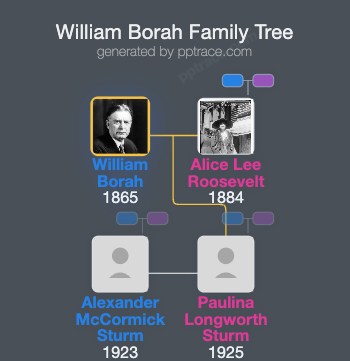
Family Tree
Tap  to expand more relatives
Introduction
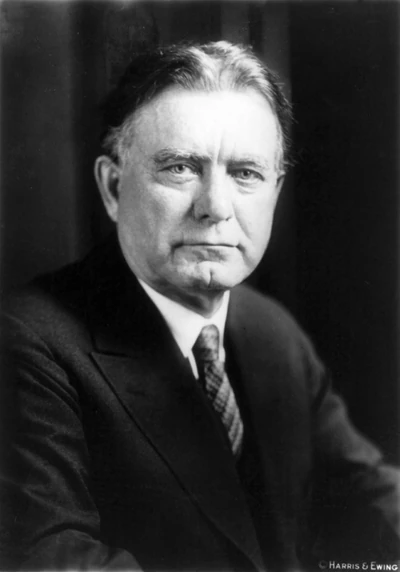
William Edgar Borah was born on June 29, 1865, in Jasper Township, Illinois, near Fairfield in Wayne County. His parents were Elizabeth (West) Borah and William Nathan Borah, who farmed in the region. Borah was the seventh of ten children and the third son in the family. His ancestors came to America around 1760, fought in the Revolutionary War, and migrated westward with the expanding frontier. Distantly related to Katharina von Bora, a Catholic nun who married Martin Luther in the 16th century, Borah's family history includes a long-standing American presence.
Borah's early education was at Tom's Prairie School near Fairfield. He later attended Southern Illinois Academy at Enfield, intending to prepare for the ministry. However, he was expelled in 1882 due to disruptive behavior, leading to a brief period of running away with an itinerant Shakespearean troupe. Subsequently, Borah developed an interest in law and decided to pursue that profession. In 1883, he moved to Lyons, Kansas, where he lived with his sister Sue and her husband, Ansel M. Lasley, an attorney. Borah initially worked as a teacher but struggled with the profession and returned to studying law under Lasley's supervision.
In 1885, Borah enrolled at the University of Kansas, where he studied alongside future notable figures such as William Allen White and Fred Funston. His studies were interrupted by a diagnosis of tuberculosis in early 1887, which necessitated his return to Lyons for recovery. After recuperation, Borah read law by apprenticeship, passing the bar exam in September 1887. He became a lawyer and formed a partnership with Lasley.
In 1889, Borah was appointed city attorney of Lyons. Seeking broader opportunities, he decided to move west, inspired by advice often attributed to Horace Greeley. In October 1890, Borah traveled by train on the Union Pacific Railroad and settled in Boise, Idaho, where his financial resources had brought him. At the time, Idaho had been admitted as a state earlier that year, and Boise was experiencing rapid growth.
In Idaho, Borah established himself as a lawyer and entered politics. His first legal case involved defending a man accused of murder for shooting a Chinese immigrant in the back. Although Borah secured an unrequested dismissal, his legal career prospered. He served as chairman of Idaho's Republican State Central Committee in 1892 and as a political secretary to Governor William J. McConnell. In 1895, he married Mary McConnell, daughter of the governor; the marriage lasted until his death, but they had no children.
Borah's early career was marked by engagement with the labor conflicts characteristic of Idaho's mining region. In 1899, during a miners' strike, Borah prosecuted Paul Corcoran, union secretary, for murder related to a dynamite attack on a mining facility. Borah's dramatization during the trial garnered attention, and Corcoran was convicted, although his death sentence was later commuted and himself pardoned in 1901.
Borah attempted to enter national politics by running for the U.S. House of Representatives in 1896 but was unsuccessful. During that period, he supported William Jennings Bryan and identified as a Silver Republican, opposing William McKinley's campaign. He continued to advocate for the silver cause and supported the Spanish–American War in 1898. By 1900, Borah had rejoined the Republican Party, aligning himself with its presidential candidate William McKinley's campaign.
Borah’s political career culminated in his election to the United States Senate in 1907. He served as a senator from Idaho continuously until his death in 1940. During his tenure, he was known for his progressive views and for challenging President William Howard Taft's policies. Despite voting in favor of entering World War I in 1917, he became a noted isolationist afterward, leading the group known as the Irreconcilables who opposed the Treaty of Versailles and U.S. league membership.
In the 1920s and 1930s, Borah often clashed with sitting presidents, including Calvin Coolidge, who once considered selecting him as his running mate in 1924. Borah supported Herbert Hoover’s presidential campaign in 1928, a rare act of party loyalty for him. After Republicans lost control of the Senate in 1933, Borah was no longer chairman of the Senate Foreign Relations Committee but maintained a degree of influence. He sought the Republican nomination for president in 1936 but was not considered a leading contender by party leaders.
In his later years, Borah expressed interest in European diplomacy and speculated about possible meetings with Adolf Hitler, which did not occur. William Borah died on January 19, 1940. His statue was later placed in the National Statuary Hall Collection, presented by Idaho in 1947.