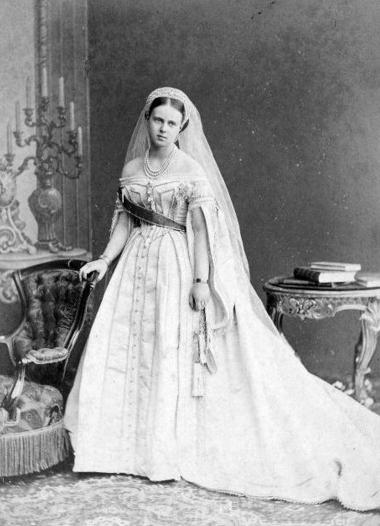
Grand Duchess Maria Alexandrovna Of Russia
| Name | Grand Duchess Maria Alexandrovna Of Russia |
| Title | Russian grand duchess 1853-1920 |
| Gender | Female |
| Birthday | 1853-10-17 |
| nationality | Russian Empire |
| Source | https://www.wikidata.org/wiki/Q158154 |
| pptrace | View Family Tree |
| LastUpdate | 2025-11-12T01:18:16.344Z |
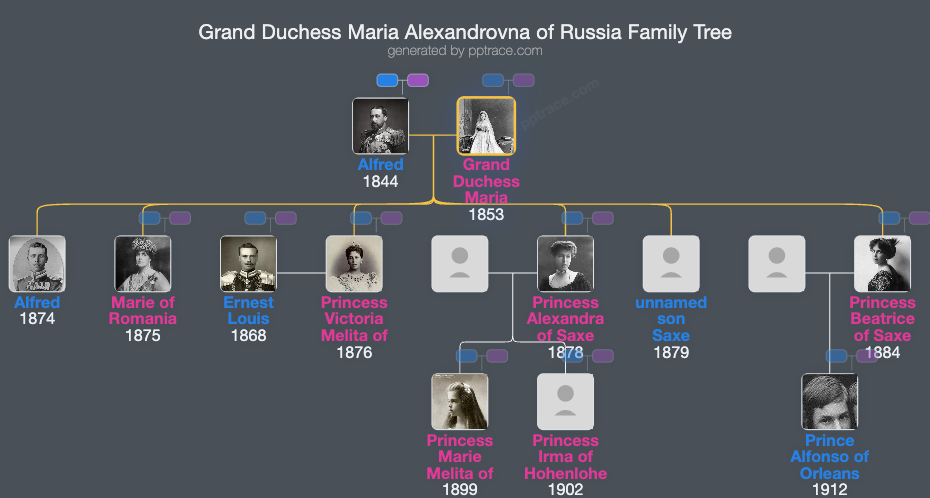
Family Tree
Tap  to expand more relatives
Introduction
Grand Duchess Maria Alexandrovna of Russia was born on October 17, 1853, at the Alexander Palace in Tsarskoye Selo, Russian Empire. She was the sixth child and only surviving daughter of Emperor Alexander II of Russia and his first wife, Empress Maria Alexandrovna (née Princess Marie of Hesse and by Rhine). Her paternal grandfather was Nicholas I of Russia. Maria's early childhood was spent within the imperial court amidst luxurious surroundings, including residences such as the Winter Palace in Saint Petersburg, Gatchina, and Tsarskoye Selo.
She was raised under a strict educational regime at the Russian court, directed by her governess, Countess Alexandra Tolstaya. Maria was the first Russian grand duchess to be raised by English nannies and to speak fluent English, in addition to her native Russian, as well as German and French. Her education included a broad cultural exposure, and she was known to have met Mark Twain in 1867 during her family's stay at Livadia Palace in Crimea.
Maria's family history includes her marriage in 1874 to Prince Alfred, Duke of Edinburgh, second son of Queen Victoria and Prince Albert of Saxe-Coburg and Gotha. She was the only Romanov to marry into the British royal family. They met initially in 1868 and 1871, developing affection despite family opposition. Negotiations for the marriage included detailed arrangements in the marriage treaty, which provided Maria with a substantial dowry consisting of monetary provisions and personal jewels, including significant Romanov heirlooms and a specially commissioned parure of diamonds and Burmese rubies.
The wedding took place on January 23, 1874, in the Grand Church of the Winter Palace, in a ceremony combining Russian Orthodox and Anglican rites. Following her marriage, Maria moved to England, residing mainly at Clarence House in London and occasionally returning to Russia and Germany. Queen Victoria described her as pleasing, cheerful, and morally suited for her role. The couple had five children: Alfred (born October 15, 1874), Marie (born October 29, 1875), Victoria Melita (born November 25, 1876), Alexandra (born September 1, 1878), and Beatrice (born April 20, 1884). Maria was known for her hands-on approach, including nursing her children herself.
In 1874, Maria and Alfred settled in England, and her relationship with Queen Victoria was marked by occasional disagreements over court precedence and courtesies. Maria's interactions with her mother-in-law, as well as her personal mannerisms and attitude, occasionally caused tensions at court. She remained devoted to her native Russia, which she often visited, while also experiencing frequent homesickness.
In 1886, the Duke of Edinburgh was appointed commander-in-chief of the British Mediterranean Fleet, leading the family to settle in Malta for three years. Subsequently, in 1887, the family moved to Coburg upon the Duke inheriting the Duchy of Saxe-Coburg and Gotha after the death of his uncle, Ernest II. Maria enjoyed her new role, engaging in cultural and charitable activities, and was involved in updating the castles and estates in her domain.
Maria's marital life was strained by her husband's alcohol problems and distant demeanor. Their son, Young Alfred, died in 1899 at age twenty-four, suffering from syphilis and possibly suicide. Her husband contracted throat cancer and died in 1900. Maria then became Dowager Duchess of Saxe-Coburg and Gotha and resided mainly in Coburg, Gotha, and her villa near Lake Tegernsee in Bavaria.
During the outbreak of World War I, she sided with Germany due to her German ties but faced hostility for her connections to both Russia and Britain, leading her to live in exile in Switzerland. Her family suffered considerable losses during the Russian Revolution, including her brother Grand Duke Paul and her nephew Tsar Nicholas II and his family. She endured financial hardship after losing her fortune, much of which was held in Russia.
Maria Alexandrovna died on October 22, 1920, in exile in Switzerland, at the age of 67. She was buried alongside her husband and son at the ducal mausoleum in Coburg. Her correspondence, including letters to her daughter Alexandra, is preserved in the Hohenlohe Central Archive in Neuenstein, Germany. Her honors included the Dame Grand Cross of the Order of Saint Catherine, and numerous other decorations from various countries.