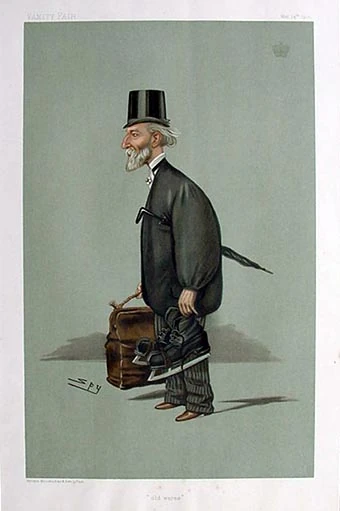
Hubert De Burgh-Canning, 2nd Marquess Of Clanricarde
| Name | Hubert De Burgh-Canning, 2nd Marquess Of Clanricarde |
| Title | British politician and peer (1832–1916) |
| Gender | Male |
| Birthday | 1832-11-30 |
| nationality | United Kingdom of Great Britain and Ireland |
| Source | https://www.wikidata.org/wiki/Q5927716 |
| pptrace | View Family Tree |
| LastUpdate | 2025-11-26T23:26:40.063Z |
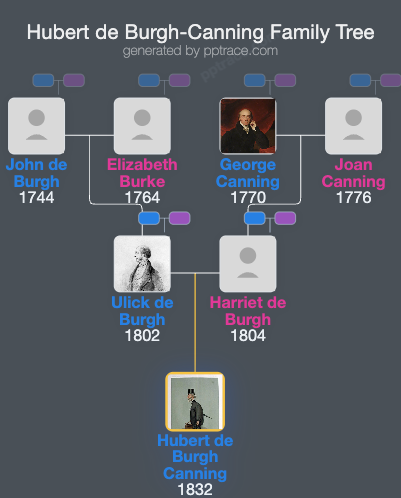
Family Tree
Tap  to expand more relatives
Introduction
Hubert George de Burgh-Canning, 2nd Marquess of Clanricarde, was born on 30 November 1832 and died on 12 April 1916. He was known earlier in his life as Lord Hubert de Burgh until 1862, then as Lord Hubert de Burgh-Canning until 1867, and subsequently as Viscount Bourke until 1874. He was an Anglo-Irish nobleman and politician, with familial ties to prominent political figures, notably being the grandson of British Prime Minister George Canning.
Early Life and Education:
He was the son of the 1st Marquess of Clanricarde and Harriet Canning, daughter of George Canning. Hubert was educated at Harrow School. In 1852, he began a diplomatic career as an attaché in Turin, later becoming Second Secretary in Turin in 1862. He adopted the surname Canning upon inheriting his uncle Earl Canning's estates.
Political Career:
Following the death of his elder brother, Lord Dunkellin, a Liberal Member of Parliament (MP) for County Galway from 1865 until 1867, Hubert succeeded him as heir to both the Marquessate and Lord Dunkellin’s parliamentary seat. He was elected as a Liberal MP for County Galway in 1867 and was re-elected in 1868. He served until his retirement from Parliament in 1871. During this period, he was known by the courtesy title Viscount Bourke, a subsidiary title of his father.
He inherited his father's peerages in 1874, becoming the 2nd Marquess of Clanricarde. His peerages included titles in the Peerage of Ireland and as Baron Somerhill in the Peerage of the United Kingdom, granting him a seat in the House of Lords.
Landholdings and Reputations:
His estate centered around Portumna in County Galway, covering approximately 52,000 acres, primarily agricultural land producing rents estimated at about £25,000 annually during his lifetime (equivalent to approximately £3.1 million in 2023). He was an absentee landlord with a reputation for being notably repressive in Ireland. His estate was targeted during the Irish Land War, specifically during the 1887 Plan of Campaign advocating for fair rents. Clanricarde's opposition to the campaign was severe, with some describing his approach as obdurate.
The land agent for his estate, John Henry Blake, was murdered in 1882. Official correspondence indicates that Clanricarde prioritized eviction threats to enforce contractual obligations. In 1888, he was the subject of a proposed bill for estate expropriation, supported by Irish parliamentarians, and publicly denounced by British Prime Minister Sir Henry Campbell-Bannerman. Despite numerous evictions, Clanricarde never visited his Irish estates. The Irish Parliamentary Party viewed him unfavorably, and a parliamentary vote in favor of expropriation passed with vast majority support.
Attempted Land Purchases and Death:
Beginning in 1891, the Congested Districts Board sought to purchase his estate compulsorily, and they succeeded in acquiring it in 1915. Hubert de Burgh-Canning died in 1916 at the age of 83. At the time, he resided at 13 Hanover Square, London, and was buried in Highgate Cemetery. His estate was valued at a probate amount of £2,500,000, roughly equivalent to £214.1 million in 2023.
His vast fortune was inherited by his sister’s grandson, Henry, Viscount Lascelles, who married Princess Mary in 1922. Upon his death, his peerages became extinct, except for the second creation of the Earldom of Clanricarde, which passed to the 6th Marquess of Sligo by special remainder.