Caroline Branham
| Name | Caroline Branham |
| Title | slave at Mount Vernon |
| Gender | Female |
| Birthday | 1764-01-01 |
| nationality | — |
| Source | https://www.wikidata.org/wiki/Q104680031 |
| pptrace | View Family Tree |
| LastUpdate | 2025-11-28T20:10:18.847Z |
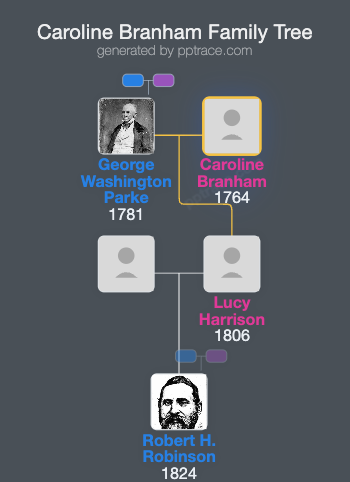
Family Tree
Tap  to expand more relatives
Introduction
Caroline Branham (circa 1764 – 1843) was an enslaved woman born in 1764 at Mount Vernon, the estate of George and Martha Washington. Her mother was enslaved and owned by Daniel Parke Custis, who died in 1757 without leaving a will, leaving Martha Custis (later Martha Washington) with a life interest in one-third of his estate, including enslaved people. After Custis's death, the enslaved people, including Branham, became part of Martha Washington's estate, and they were classified as dower slaves. Following her marriage in 1759 to George and Martha Washington, she was effectively under their ownership.
Branham served as a housemaid and seamstress in the Washington household. Her daily responsibilities involved early morning preparation, including lighting fireplaces and preparing the mansion for the day, and continued into the evening. Her duties encompassed household cleaning, laundry, bed-making, care for visitors, and caring for family members. She operated a bell system to summon domestic staff and helped prepare the mansion for visitors and guests, including specific tasks such as making beds with fresh linens, emptying chamber pots, and providing water for washing. She also sewed clothing for enslaved individuals on the estate and wore a simple, functional attire suitable for domestic labor, including ankle-length gowns, aprons, shoes with buckles, stockings, corsets, and caps.
Branham was also involved in managing her own work pace, occasionally practicing passive resistance by working slower or not meeting quotas, though she was valued for her skills. George Washington expressed concern that she might be taken advantage of, noting her possession of fabric pieces for mending and her husband Hardiman’s longer-than-necessary travel times within Mount Vernon’s farms.
Her personal life included a marriage to Peter Hardiman, a groom in Washington's stables, whose slaveholder was David Stuart. Their relationship began during visits to Mount Vernon when Eleanor Calvert, Hardiman's mistress, visited, and eventually they married around 1787. They had nine children together, seven with Hardiman, and at least two children—Austin (1798–1879) and Lucy—are believed to have been fathered by George Washington Parke Custis rather than their enslaved parent, given scholarly insights.
During the American Revolution, George Washington was commander of the Continental Army and away from Mount Vernon from 1775 to 1783. After his resignation in 1783, Washington aimed to make Mount Vernon self-sufficient, establishing mills, blacksmith shops, brickworks, and other enterprises to produce necessary goods, including clothing sewn by enslaved seamstresses like Branham.
George Washington became the first President of the United States in 1789 and served until 1797, with occasional visits to Mount Vernon during his presidency. His death occurred on December 14, 1799. Branham was present when Washington died, as recorded by his lawyer Tobias Lear. Washington’s will stipulated the manumission of 123 enslaved individuals after Martha Washington’s death, which she executed by freeing them on January 1, 1801. However, some enslaved people remained, including those classified as dower slaves, over whom Washington and Martha had limited authority due to laws governing dower estate.
After Martha Washington’s death in 1802, Branham, her children, and Peter Hardiman were inherited by Martha’s grandson, George Washington Parke Custis. Hardiman oversaw the care of Custis’s horses and other livestock, living with the family on the Arlington House estate, where Branham and her children resided in a cottage. Around 1806, she gave birth to a daughter named Lucy, whose parentage is believed to be Custis, based on scholarly research. The estate at Arlington House served as her home until her death in 1843.
Branham's life intersected multiple significant historical events, including the Revolutionary War, the early presidency of George Washington, and the subsequent estate management. Her personal history offers insights into the experiences of enslaved domestic workers in 18th and early 19th-century America.