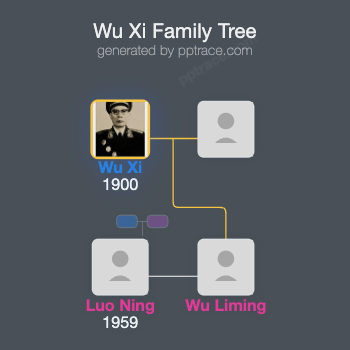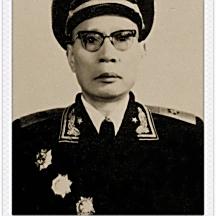
Wu Xi
| Name | Wu Xi |
| Title | Chinese military personnel |
| Gender | Male |
| Birthday | 1900-00-00 |
| nationality | People's Republic of China |
| Source | https://www.wikidata.org/wiki/Q8323843 |
| pptrace | View Family Tree |
| LastUpdate | 2025-10-01T10:11:36.932Z |
Family Tree
Tap  to expand more relatives
Introduction
Wu Xi, originally named Wu Youliang, was an ethnic Zhuang born in October 1900 in Sanha Village, Qu Li Township, Fusui County, Guangxi Zhuang Autonomous Region, China. His family was impoverished peasantry. In 1919, he began attending the county’s higher elementary school. During his studies, influenced by the May Fourth Movement, he started reading Sun Yat-sen’s writings on the Three Principles of the People and actively promoted New Culture ideas, opposing Confucian classics and filial piety, showing a strong patriotic spirit during this period.
In 1923, Wu Xi enrolled at the Guangxi Provincial Third Normal School in Nanning. However, due to the chaos caused by warlord conflicts, social order in Nanning was severely disrupted. He dropped out twice, returning to his hometown to work in agriculture. In 1925, with support from the New Guangxi Clique, the region unified under the Guangzhou National Revolutionary Government, and Guangxi's political situation gradually stabilized. During this period, the peasant movement led by Wei Absorbed Quang had a profound influence on Wu Xi. Inspired by this, Wu Xi actively joined the Nanning patriotic student movement led by the Chinese Communist Party and was elected to the Executive Committee of the Student Union of the Third Normal School. During the peasant revolutionary movement in Nanning, he received Marxist education.
In April 1927, Wu Xi prepared to join the Chinese Communist Youth League. However, the April 12 Counter-Revolutionary Coup occurred, and in May 1927, he was arrested and imprisoned by the Kuomintang’s reactionary military police in Nanning. During his imprisonment, he left a farewell letter, demonstrating strong revolutionary will and firm belief in Communist ideals. Despite brutal torture, he maintained his faith. He was released in January 1928, after which he returned to his hometown to farm and also worked as a teacher at the Zuo County High School, serving as acting principal and continuing to promote Sun Yat-sen’s New Three Principles of the People.
In October 1929, Wu Xi enlisted in the military, serving as Political Instructor of the Independent Battalion of the Fifth Border Guard in Guangxi. That same year, he officially joined the Chinese Communist Party. In 1930, he participated in the Longzhou Uprising and held various military and political positions, including Political Instructor of the Eighth Red Army, Deputy Director of the Political Department of the Jizhong Military District, Director of the First School of North China in Shijiazhuang, Director of the Political Department of the North Sichuan Military District, and key positions related to the navy. In 1955, he was awarded the rank of Major General.
After retirement, Wu Xi mainly engaged in compiling historical materials, writing, calligraphy, and participating in cultural and sports activities. He published works such as *Old Steed Remembering the Flames*, *Old Steed’s Poetry Collection*, and *Selected Poems and Lyrics of Wu Xi*. His calligraphy art was exhibited multiple times, and in 2004, his collection *Wu Xi Calligraphy* was published. In July 2005, he passed away in Beijing. His body was laid to rest according to his wishes—a half in his birthplace Fusui County and the other half at the Longzhou Revolutionary Martyrs' Cemetery.
Wu Xi's life and works broadly reflect his deep revolutionary experience and rich cultural achievements. He excelled in calligraphy, poetry, and memoirs, becoming a notable figure with considerable influence in Guangxi and across the country.