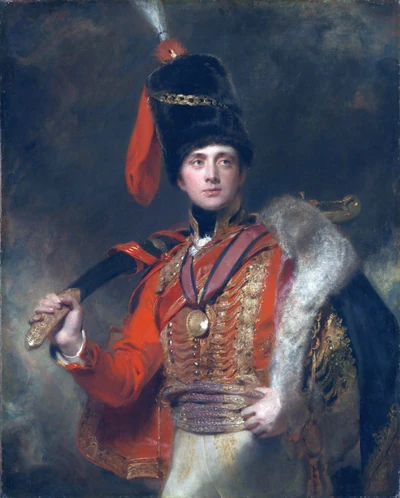
Charles Vane, 3rd Marquess Of Londonderry
| Name | Charles Vane, 3rd Marquess Of Londonderry |
| Title | British soldier, politician and nobleman (1778-1854) |
| Gender | Male |
| Birthday | 1778-05-18 |
| nationality | Republic of Ireland |
| Source | https://www.wikidata.org/wiki/Q2268227 |
| pptrace | View Family Tree |
| LastUpdate | 2025-11-26T23:32:51.986Z |
Family Tree
Tap  to expand more relatives
Introduction
Charles William Vane, 3rd Marquess of Londonderry (originally Stewart), was born on 18 May 1778 in Dublin and died on 6 March 1854. He was an Anglo-Irish nobleman, soldier, and politician.
Family Background:
His father was Robert Stewart, who was created Viscount Castlereagh in 1795 and subsequently Marquess of Londonderry in 1816. His mother was Frances Pratt, an Englishwoman and daughter of Charles Pratt, 1st Earl Camden. Charles Stewart was the second son of Robert Stewart and Frances Pratt and was raised in the Church of Ireland (Anglican). He had a half-brother from his father's first marriage, Robert (1769–1822), known as Lord Castlereagh, who served as Foreign Secretary. Charles had twelve full siblings.
Early Life and Education:
Charles was brought up in Ireland and received his early education in Dublin. His family had Ulster-Scots roots and were originally Presbyterians before converting to Anglicanism.
Military and Political Career:
In 1791, at age 12, Stewart joined the British Army as an ensign in the 108th Regiment. He was promoted to lieutenant in 1793 and served in the Flanders Campaign of the French Revolutionary Wars in 1794 and on the Rhine and Danube in 1795. During the Irish Rebellion of 1798, he was lieutenant-colonel of the 5th Royal Irish Dragoons. In 1803, he was appointed aide-de-camp to King George III.
In Parliament, Stewart was elected in 1800 as a member of the Irish House of Commons for Thomastown borough and then for County Londonderry after the Act of Union in 1801. He was re-elected numerous times and served as Under-Secretary of State for War and the Colonies. In July 1814, he was elevated to the House of Lords after being summoned as a peer.
Marriages and Children:
His first marriage was to Lady Catherine Bligh on 8 August 1804; she was the daughter of the 3rd Earl of Darnley. They had one son, Frederick William Robert Stewart (1805–1872), who became the 4th Marquess of Londonderry. Lady Catherine died in February 1812.
In 1819, Stewart married Lady Frances Vane-Tempest, daughter and heiress of Sir Henry Vane-Tempest and Anne MacDonnell. She was significantly younger than him. They had six children:
- George Henry Robert Charles William Vane-Tempest (1821–1884), who became the 5th Marquess of Londonderry
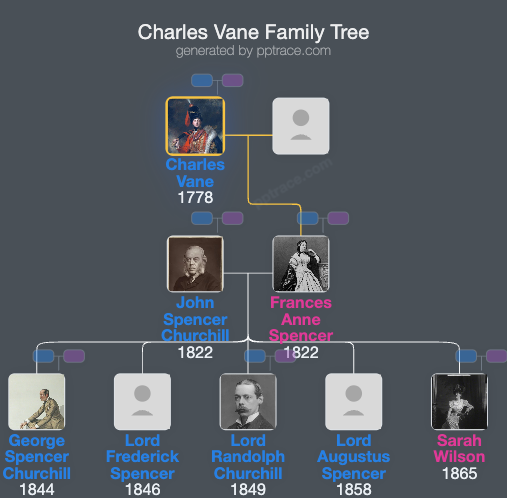
- Lady Frances Anne Emily Vane (1822–1899), married John Spencer-Churchill, 7th Duke of Marlborough
- Lady Alexandrina Octavia Maria Vane (1823–1874)
- Lord Adolphus Frederick Charles William Vane-Tempest (1825–1864)
- Lady Adelaide Emelina Caroline Vane (c. 1830–1882)
- Lord Ernest McDonnell Vane-Tempest (1836–1885)
Peninsular War:
During the Napoleonic Wars, Stewart participated in the Peninsular War. He commanded a cavalry brigade part of the Corunna Campaign (1808–1809) under Sir John Moore, where he notably engaged in the cavalry clash of Benavente. He was wounded during the retreat. After Sir John Moore’s death at the Battle of Corunna, Stewart was sent back to London with dispatches.
In April 1809, he became Adjutant General to Sir Arthur Wellesley (later Duke of Wellington). He distinguished himself at the Second Battle of Porto (May 1809), at Talavera (July 1809), Bussaco (September 1810), and Fuentes de Oñoro (May 1811). He resigned in 1812, possibly due to health issues or disagreements with Wellington. He served under Emperor Alexander I of Russia in 1813–1814 and was honored with a medal by Russia in 1836.
Diplomatic Service:
His half-brother, Robert Stewart, helped him begin a diplomatic career. Stewart served as Envoy Extraordinary and Minister Plenipotentiary to Berlin from May 1813 until the end of the war. He was wounded at the Battle of Kulm in August 1813. In 1814, he was appointed Ambassador to Austria, a position he held until 1823. In 1814, he was ennobled as Baron Stewart by the Prince Regent. He was also made a Knight Companion of the Bath and a Colonel of the 25th Light Dragoons.
At the Congress of Vienna, he attended as part of the British delegation alongside his half-brother Lord Castlereagh. He gained a reputation for unrefined behavior, which earned him the nickname "Lord Pumpernickel."
Later Life:
In 1822, Stewart succeeded his half-brother as the 3rd Marquess of Londonderry, inheriting estates in Ireland. His reputation suffered during the Great Famine due to his strict landlord policies. He also engaged in coal mining operations in County Durham, insisting on the use of child labor, opposing the Mines and Collieries Act 1842.
He died in 1854, leaving behind a legacy of military service and diplomatic involvement.