Joseph P. Kennedy Jr.
| Name | Joseph P. Kennedy Jr. |
| Title | junior officer in the United States Navy and elder brother of John F. Kennedy |
| Gender | Male |
| Birthday | 1915-07-25 |
| nationality | United States of America |
| Source | https://www.wikidata.org/wiki/Q505178 |
| pptrace | View Family Tree |
| LastUpdate | 2025-11-17T06:44:50.134Z |
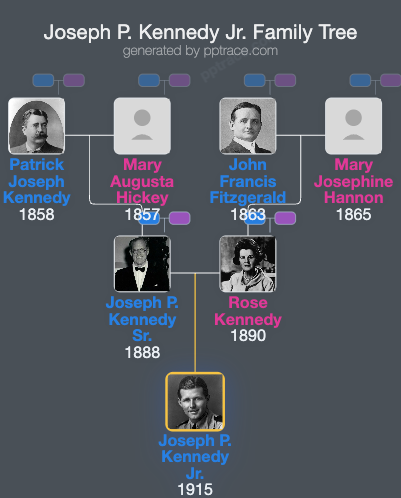
Family Tree
Tap  to expand more relatives
Introduction
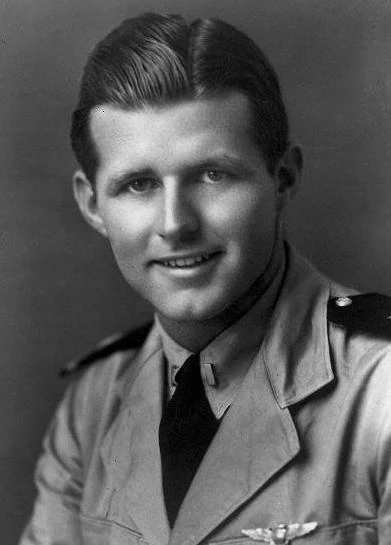
Joseph Patrick Kennedy Jr. was born on July 25, 1915, at a summer rental cottage on Nantasket Beach in Hull, Massachusetts. He was the eldest of nine children born to Joseph P. Kennedy Sr. and Rose Fitzgerald Kennedy. Kennedy attended the Dexter School in Brookline, Massachusetts, along with his brother John Kennedy. In 1933, he graduated from Choate, a preparatory boarding school located in Wallingford, Connecticut. Following high school, Kennedy studied for one year under Harold Laski at the London School of Economics. He subsequently enrolled at Harvard College, where he graduated in 1938 with a Bachelor of Arts degree. During his time at Harvard, Kennedy participated in football, rugby, and crew, and he served on the student council. After completing his undergraduate degree, he enrolled at Harvard Law School, though he interrupted his studies to enlist in the United States Navy.
Kennedy was involved in politics from a young age; he was a Massachusetts delegate to the 1940 Democratic National Convention and had plans to run for a seat in the U.S. House of Representatives following his military service. His father, Joseph P. Kennedy Sr., held ambitions for him to become President of the United States.
Kennedy's early views included admiration for Nazi Germany, which he expressed after a 1934 visit to the country, praising aspects such as the sterilization policy. However, his opinions changed in 1939, influenced by Aimée de Heeren, a Brazilian secret service agent based in Paris.
Kennedy left Harvard Law School before completing his final year to enlist in the U.S. Naval Reserve on June 24, 1941. He trained as a naval aviator, received his flight wings, and was commissioned as an ensign on May 5, 1942. He was initially assigned to Patrol Squadron 203 and later to Bombing Squadron 110. In September 1943, he was deployed to Britain, serving with Bomber Squadron 110, Special Air Unit ONE. During 1943–1944, Kennedy piloted land-based Consolidated B-24 Liberator patrol bombers on anti-submarine missions in the Atlantic.
Kennedy was promoted to the rank of lieutenant on July 1, 1944, having completed 25 combat missions. Despite being eligible to return home, he volunteered for a mission involving Operation Aphrodite, which utilized modified aircraft as drones for precision attacks. The operation aimed to target well-fortified sites such as the Fortress of Mimoyecques in France.
Operation Aphrodite involved converting aircraft like B-17 Flying Fortress and PB4Y-1 Liberator bombers into remote-controlled flying bombs. After takeoff, the crew would disconnect and parachute from the aircraft before its explosive payload was remotely detonated. On August 12, 1944, Kennedy flew a BQ-8 "robot" aircraft as part of the Navy's first Aphrodite mission. During the mission, the aircraft's explosive detonation occurred prematurely, resulting in the deaths of Kennedy and his co-pilot, Wilford J. Willy. The wreckage landed near Blythburgh, Suffolk, causing damage to local structures but no injuries on the ground.
Kennedy was posthumously awarded the Navy Cross for his service. His death led Joseph P. Kennedy Sr. to shift his political hopes from Joseph to his next son, John F. Kennedy, who subsequently became the 35th President of the United States.