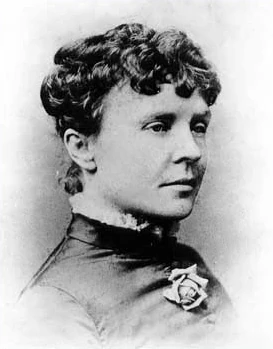
Rose Cleveland
| Name | Rose Cleveland |
| Title | First Lady of United States (1846-1918) |
| Gender | Female |
| Birthday | 1846-06-13 |
| nationality | United States of America |
| Source | https://www.wikidata.org/wiki/Q255611 |
| pptrace | View Family Tree |
| LastUpdate | 2025-11-17T06:41:33.475Z |
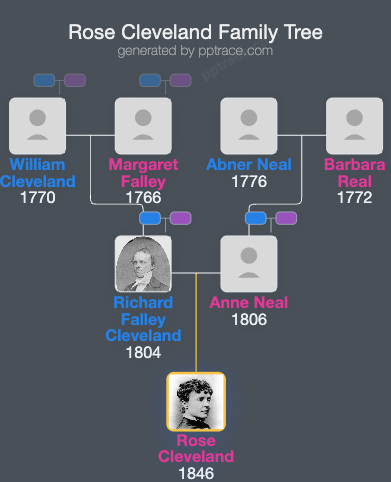
Family Tree
Tap  to expand more relatives
Introduction
Rose Elizabeth Cleveland was born in Fayetteville, New York, on June 13, 1846. She was the ninth and youngest child of Reverend Richard Falley Cleveland and Ann Neal Cleveland. The Cleveland family arrived in the United States with Moses Cleveland, who settled in the Massachusetts Bay Colony in 1635 after emigrating from Ipswich, England. On her mother's side, Cleveland was descended from Anglo-Irish and German Quaker families.
During her childhood, Cleveland engaged in outdoor activities and rejected traditional gender norms. She was raised Presbyterian and remained devoted to her faith throughout her life. The family experienced financial difficulties; in 1850, they moved to Clinton, New York, where her father worked as a district secretary for the American Home Missionary Society. In 1853, they relocated to Holland Patent, New York. Shortly afterward, her father died, leaving Cleveland as the youngest child still in the family home, "The Weeds."
Cleveland attended Houghton Seminary in Clinton from 1864 to 1866, studying Greek and Latin literature. After graduating, she worked as a teacher at her former school and later taught literature, mathematics, and Latin at the Lafayette Collegiate Institute in Lafayette, Indiana. She also taught at a girls' school in Muncy, Pennsylvania, and returned to Holland Patent to teach history and Sunday school. Cleveland delivered public lectures in New York State on topics including history and women's rights, with her lectures published by The Magazine of American History.
Her brothers Frederick and Louis died at sea in 1872 while traveling from Nassau. Cleveland subsequently cared for her mother until her mother's death in 1882, after which she inherited "The Weeds." Her brother Grover Cleveland was elected governor of New York in 1882; Cleveland declined a teaching position in New York City to assist him at the Executive Mansion. During this period, she published her first two poems in The Independent and was present at her brother's presidential election and inauguration in 1885.
In 1885, Grover Cleveland became President of the United States, and due to the absence of a wife, he asked Cleveland to serve as acting First Lady. She accepted the role but was more interested in academic pursuits than social duties. Cleveland organized social events at the White House, primarily receptions in the Blue Room, but often found such activities monotonous. She was known for her intellectual demeanor, which included conversing with classical quotations and knowledge of languages.
During her tenure as acting First Lady, Cleveland published her first book, *George Eliot's Poetry, and Other Studies.* Though initially not regarded as an intellectual by the press, her role as First Lady elevated her profile, leading to financial earnings of approximately $25,000 in royalties from twelve editions. Her close friends during this period included historian Laura Carter Holloway and her predecessor, Mary Arthur McElroy, both of whom were sisters of Presidents and served as White House hostesses.
Cleveland was described as "masculine" and a "bluestocking," with a firm demeanor that could be intimidating. She also showed signs of fashion interest, favoring bright dresses. She publicly supported women's suffrage, the temperance movement—including the banning of wine in the White House—and Indigenous sovereignty. However, some of her views reflected the prejudices of her time, including caution in the appointment of Catholics and discriminatory attitudes regarding African Americans and the working class.
She maintained strong progressive opinions and was involved in political discourse. She supported moving beyond traditional Victorian dress reforms but wore low-cut dresses exposing her shoulders, which was considered controversial. Upon her brother’s marriage to Frances Folsom in 1886, Cleveland helped organize the wedding and subsequently left the White House but continued to engage in social events.
After her White House service, Cleveland moved to Chicago to become the editor of *Literary Life* magazine. She rejected her brother's financial offer to avoid dependency and sought to maintain independence. Her editorial career was brief due to illness and the magazine's difficulties.
In her later years, Cleveland moved to Italy, where she dedicated herself to assisting war refugees during World War I and Spanish flu patients. She contracted the flu herself and died in 1918. Cleveland was also known for her involvement in aiding refugees and patients during the Spanish flu pandemic, and her advocacy for women’s rights and independence persisted throughout her life.