Prince Christian Victor Of Schleswig-Holstein
| Name | Prince Christian Victor Of Schleswig-Holstein |
| Title | English cricketer (1867-1900) |
| Gender | Male |
| Birthday | 1867-04-14 |
| nationality | United Kingdom of Great Britain and Ireland |
| Source | https://www.wikidata.org/wiki/Q836119 |
| pptrace | View Family Tree |
| LastUpdate | 2025-11-12T01:17:47.848Z |
Family Tree
Tap  to expand more relatives
Introduction
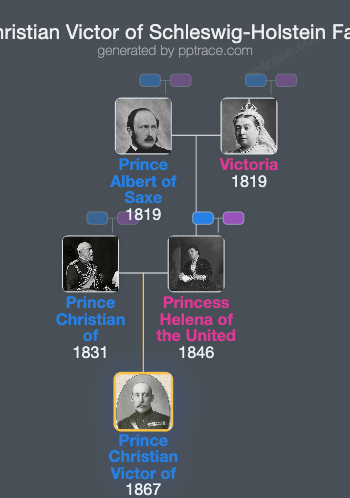
Prince Christian Victor Albert Louis Ernst Anton of Schleswig-Holstein was born on 14 April 1867 at Windsor Castle in the United Kingdom. He was the eldest son of Princess Helena, the third daughter of Queen Victoria, and Prince Christian of Schleswig-Holstein, the third son of Christian, Duke of Augustenborg, and Countess Louise Sophie of Danneskiold-Samsøe.
His parents resided at Cumberland Lodge in the United Kingdom, and he was considered a member of the British royal family. By letters patent issued in 1866, he was styled His Highness Prince Christian Victor of Schleswig-Holstein. He was baptized in the private chapel at Windsor Castle, with notable godparents including Queen Victoria (his maternal grandmother), the Duke of Augustenburg (his paternal grandfather, represented by Prince Arthur), the Prince of Wales, the Crown Princess of Prussia (represented by Princess Louise), the Duke of Saxe-Coburg and Gotha (represented by the Duke of Edinburgh), and the Dowager Princess of Hohenlohe-Langenburg (represented by Lady Churchill).
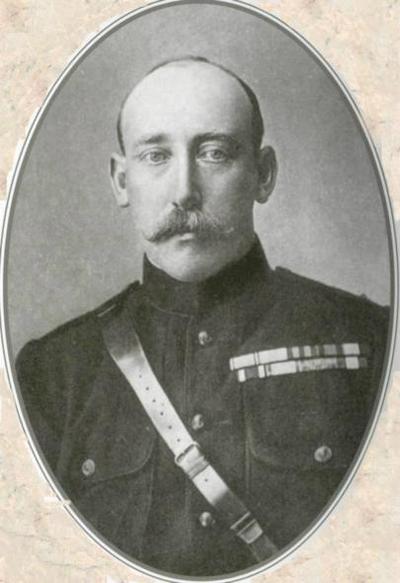
For his education, Christian Victor attended Lambrook, Wellington College, Magdalen College at Oxford University, and the Royal Military College, Sandhurst. He was commissioned into the King's Royal Rifle Corps (60th Rifles) in 1888, serving in the 4th Battalion. Notably, he was the first member of the British royal family to attend formal schooling rather than being educated at home by a tutor. While at Wellington College, he played cricket and served as captain of the college's First Eleven in 1883, as well as captain of the cricket teams at Magdalen College and Sandhurst. He made a single first-class cricket appearance for I Zingari against the Gentlemen of England in 1887.
In his military career, Christian Victor served in various campaigns. Upon completing Sandhurst in 1888, he joined the British Army with the King's Royal Rifle Corps and was posted to India, participating in expeditions such as Hazara and Miranzi in 1891 and the Isazi expedition in 1892. He later served in West Africa during the Ashanti Expedition in 1895, in what is present-day Ghana. Following his return, he was promoted to the rank of Major. In 1898, he served under Lord Kitchener in the campaign near Khartoum, which led to the defeat of the Dervishes in Omdurman and the recapture of the Sudan. In 1899, he served as a staff officer during the Second Boer War, participating in the relief of Ladysmith and subsequent actions with Lord Roberts in Pretoria.
Christian Victor maintained an interest in cricket throughout his life. He played one first-class match in 1897 for I Zingari, scoring 35 runs in the first innings. He also founded his own cricket team and represented Wellington College at the sport.
In October 1900, while in Pretoria during the Second Boer War, Christian Victor contracted malaria and died of enteric fever on 29 October 1900 at the age of 33. His death occurred after receiving Holy Communion in the presence of Lord Roberts and Prince Francis of Teck. He was buried in Pretoria Cemetery on 1 November 1900, where his grave is marked by a granite cross and cast-iron railing.
Following his death, Queen Victoria expressed her grief in her journal, noting the loss of her "dear, excellent, gallant boy." His sister, Princess Marie Louise, reported a posthumous encounter with his apparition in her memoir, describing him as being dressed in army khaki and seated with his dachshund on his knee.
A monument dedicated to Christian Victor exists in the Chapel of the Crucifixion at Frogmore Mausoleum and was originally placed in St George's Chapel. There are additional memorials including a statue outside Windsor Castle and a window dedicated to him in the Royal Chapel of All Saints in Windsor Great Park, established in 1905. His biographer, T. Herbert Warren, published a biography of him in 1903.
His honors included the Knight Grand Cross of the Order of the Bath (GCB), Knight Grand Cross of the Royal Victorian Order (GCVO), and the Distinguished Service Order (DSO), among others. He received medals related to his military service, including the Queen Victoria Golden Jubilee Medal, the India General Service Medal, the Ashanti Star, the Queen’s Sudan Medal, and the Queen’s South Africa Medal. Internationally, he was awarded honors such as the Knight of the Red Eagle from Prussia and the Grand Cross of the Saxe-Ernestine House Order.