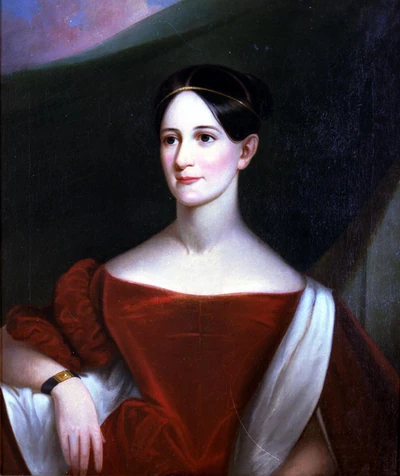
Sarah Yorke Jackson
| Name | Sarah Yorke Jackson |
| Title | First Lady of the United States (1803-1887) |
| Gender | Female |
| Birthday | 1803-07-16 |
| nationality | United States of America |
| Source | https://www.wikidata.org/wiki/Q444561 |
| pptrace | View Family Tree |
| LastUpdate | 2025-11-17T06:38:24.198Z |
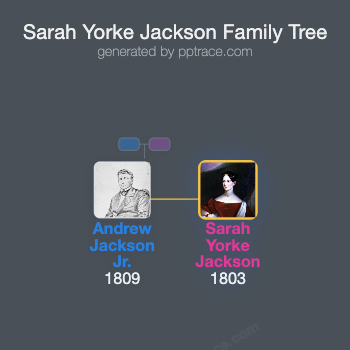
Family Tree
Tap  to expand more relatives
Introduction
Sarah Jackson (née Yorke) was born in July 1805 in Philadelphia, Pennsylvania. She was born into a wealthy Quaker family; her father, Peter Yorke, was a sea captain and successful merchant, and her mother was Mary Haines Yorke. Her father died in 1815, and her mother passed away during a trip to New Orleans in 1820, leaving Sarah and her two sisters orphaned. Subsequently, she was raised by two aunts, Mrs. George Farquhar and Mrs. Mordecai Wetherill.
On November 24, 1831, Sarah Yorke married Andrew Jackson Jr., the adopted son of U.S. President Andrew Jackson. The marriage took place in Philadelphia. Due to President Jackson’s schedule, he was unable to attend the wedding. Following the marriage, the couple was invited to stay at the White House for several months, which served as an extended honeymoon. During this period, Sarah bonded with President Jackson, who regarded her akin to a daughter. Although there was speculation that she might assume the role of White House hostess, the position remained with Emily Donelson, President Jackson’s niece.
After leaving the White House, Sarah Jackson and her husband moved to the Hermitage, the Jackson family plantation in Tennessee. To differentiate her role from that of Donelson, President Jackson appointed her as the “mistress of the Hermitage.” This was partly to prevent potential conflicts and mainly to ensure Donelson’s husband remained in the White House as Jackson's secretary. Sarah Jackson gave birth to five children at the Hermitage, beginning with her daughter Rachel in 1832. On October 13, 1834, a fire destroyed much of the Hermitage. The family temporarily relocated to Hunter’s Hill, but the emotional toll prompted a return to the White House as winter approached.
Sarah Jackson arrived at the White House on November 26, 1834, and her husband Jackson financed extensive purchases to replace their belongings lost in the fire. She initially served as co-hostess alongside Emily Donelson; this was a unique occurrence in White House history. When Donelson fell seriously ill, Sarah Jackson assumed the full responsibilities of White House hostess in October 1836 and remained the sole hostess until the end of President Jackson’s term in March 1837. Her activity as hostess was limited, partly due to the death of her mother-in-law Rachel Jackson and later the death of Emily Donelson, which constrained social activities during her tenure.
Following the completion of President Jackson’s term, the Jackson family left the White House, and Sarah Jackson returned to the Hermitage. She continued to oversee the estate and cared for President Jackson until his death. In 1838, she assisted him during a spiritual crisis that led him to join the Presbyterian Church. At his death, President Jackson bequeathed her four of his female slaves.
The Hermitage was sold to the state of Tennessee in 1856; however, Sarah Jackson was permitted to remain there for the rest of her life. Her sons served in the Confederate States Army during the American Civil War; her son Samuel died at the Battle of Chickamauga. Her husband died in 1865. Sarah Yorke Jackson died on August 23, 1887, in Nashville, Tennessee, at the age of 82.
Throughout her life, Jackson’s influence on the role of first lady was limited due to her brief tenure and the social circumstances during Andrew Jackson’s presidency. By her old age, she was largely forgotten by the public, and her legacy has received minimal scholarly attention.