Thomas Watson-Wentworth
| Name | Thomas Watson-Wentworth |
| Title | British politician (1665-1723) |
| Gender | Male |
| Birthday | 1665-06-17 |
| nationality | — |
| Source | https://www.wikidata.org/wiki/Q7794922 |
| pptrace | View Family Tree |
| LastUpdate | 2025-11-26T12:24:53.039Z |
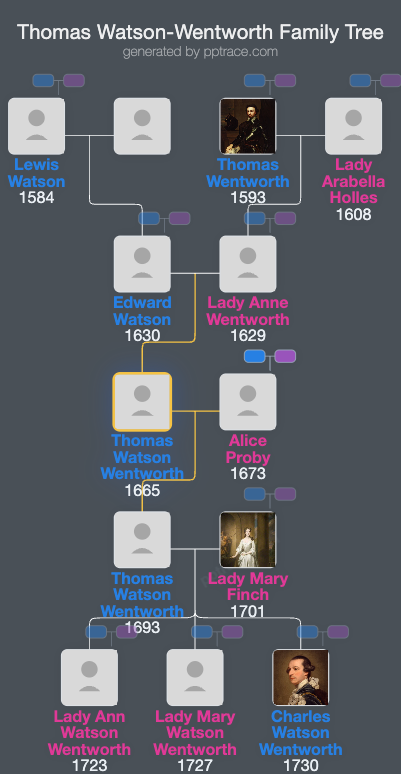
Family Tree
Tap  to expand more relatives
Introduction
Honorable Thomas Watson, later known as Thomas Watson-Wentworth (17 June 1665 – 6 October 1723), was an English landowner and politician associated with Wentworth Woodhouse in Yorkshire. He served as a Member of Parliament in the House of Commons between 1701 and 1723.
**Origins**
Thomas Watson was the third son of Edward Watson, the 2nd Baron Rockingham (1630–1689), and his wife Anne Wentworth. Anne was the daughter of Thomas Wentworth, the 1st Earl of Strafford (1593–1641), and the heiress of her childless brother William Wentworth, the 2nd Earl of Strafford (1626–1695). His eldest brother was Lewis Watson, who became the 1st Earl of Rockingham and the 3rd Baron Rockingham (1655–1724), elevated to Earl of Rockingham in 1714.
**Early Life**
Thomas Watson matriculated at Christ Church, Oxford, in 1683.
**Marriage and Children**
On 18 July 1689, Watson obtained a marriage license to marry Alice Proby, the daughter and heiress of Sir Thomas Proby, 1st Baronet. Their children included Thomas Watson-Wentworth, who later became the 1st Marquess of Rockingham (1693–1750). He was a Member of the Privy Council of Ireland and a Whig politician who rebuilt Wentworth Woodhouse in 1725, the grand structure that remains today.
**Inheritance of Wentworth Estate**
In 1695, Watson inherited the estate of his maternal uncle William Wentworth, the 2nd Earl of Strafford, which included Wentworth Woodhouse in Yorkshire, along with estates in Northamptonshire and Ireland. This inheritance was in preference to the claims of Thomas Wentworth, later created Earl of Strafford, descended from the same male line. The inheritance prompted Watson to adopt the additional surname of Wentworth, becoming Thomas Watson-Wentworth.
**Political Career**
Watson-Wentworth was first elected unopposed as a Whig MP for Bossiney in a by-election held on 21 March 1701. Although he was only a temporary fill-in, he sought another seat in the 1701 general election but chose not to stand. In the 1702 general election, he contested Higham Ferrers but was defeated. However, after the death of his opponent within a year, he was returned unopposed at a by-election for Higham Ferrers on 22 November 1703.
He served as MP for Higham Ferrers through the general elections of 1705, 1708, and 1710, typically unopposed. Initially a relatively modest participant in parliamentary affairs, Watson-Wentworth's political stance evolved, and he aligned more closely with the Tories, opposing the impeachment of Henry Sacheverell and earning recognition as a patriotic figure.
In 1713, he was elected for both Malton and Higham Ferrers but chose to represent Malton. Despite being considered whimsical or a Whig who often voted with Tories, he supported the Whigs against the expulsion of Richard Steele and in other divisions. After the 1715 general election, he and his son were elected at Malton in a contested election, but he generally voted against the government on most issues.
In the 1722 general election, Watson-Wentworth was again returned unopposed for Higham Ferrers.
**Death and Burial**
He died at Harrowden on 6 October 1723. His remains were interred in York Minster, where his monument featuring a marble effigy, sculpted by Giovanni Battista Guelphi, is located.